Table of Contents
- Why Reducing Construction Waste at Home Matters
- 1. Repair vs Replace Hard Surfaces Before Ordering Anything New
- 2. Plan Material Quantities Accurately Before Work Begins
- 3. Source Reclaimed and Surplus Materials
- 4. Recycling Construction Materials in the UK
- 5. Donate or Sell Leftover Building Materials
- 6. How to Dispose of Renovation Waste Legally and Responsibly
- 7. Reduce Construction Waste by Choosing Durable, Repairable Finishes
- Frequently Asked Questions
Last Updated: August 30, 2026
Construction and renovation projects generate substantial waste, much of it avoidable. At Surface Magic Repairs, we work daily with homeowners, landlords, and contractors to help prevent waste. This guide covers 7 ways to reduce construction waste at home, from smarter planning to responsible disposal.
According to DEFRA's construction and demolition waste statistics, construction, demolition, and excavation waste accounts for the largest share of total waste generated in England. Much of what ends up in a skip could have been repaired, reused, or redirected.
| Waste Reduction Method | Best Stage to Apply | Key Benefit |
|---|---|---|
| Repair vs replace surfaces | Before ordering materials | Avoids unnecessary disposal |
| Accurate material planning | Before work begins | Reduces over-ordering |
| Reclaimed and surplus materials | Sourcing stage | Diverts waste from landfill |
| Recycling construction materials | During and after project | Keeps materials in circulation |
| Donate or sell leftovers | After project completion | Extends material lifespan |
| Legal and responsible disposal | End of project | Ensures compliance |
| Durable, repairable finishes | Design and specification | Reduces future replacement |
Why Reducing Construction Waste at Home Matters
Reducing construction waste has direct financial and environmental impact. Every unused bag of adhesive, every length of timber cut too short, every bath ripped out for a repairable chip represents money spent twice.
Construction waste in landfill contributes to greenhouse gas emissions and depletes natural resources. Choosing to repair, reuse, or redirect materials keeps resources in circulation.
There is also a legal dimension. Householders and contractors in England and Wales have a duty of care under the Environmental Protection Act 1990 duty of care guidance to ensure waste is handled correctly. Fly-tipping renovation waste is a criminal offence.
The good news: reducing waste requires better decisions made earlier, not expensive technology or specialist knowledge.
1. Repair vs Replace Hard Surfaces Before Ordering Anything New
The single most effective way to reduce construction waste is to assess whether a surface actually needs replacing before ordering anything new. Chipped baths, cracked tiles, scratched worktops, and burn marks are routinely treated as write-offs when they are often entirely repairable.
Replacing a bath involves ripping out the existing unit, disposing of it, purchasing a new one, and dealing with knock-on disruption to surrounding tiles, plumbing, and decoration. Repairing the existing surface avoids every one of those steps.
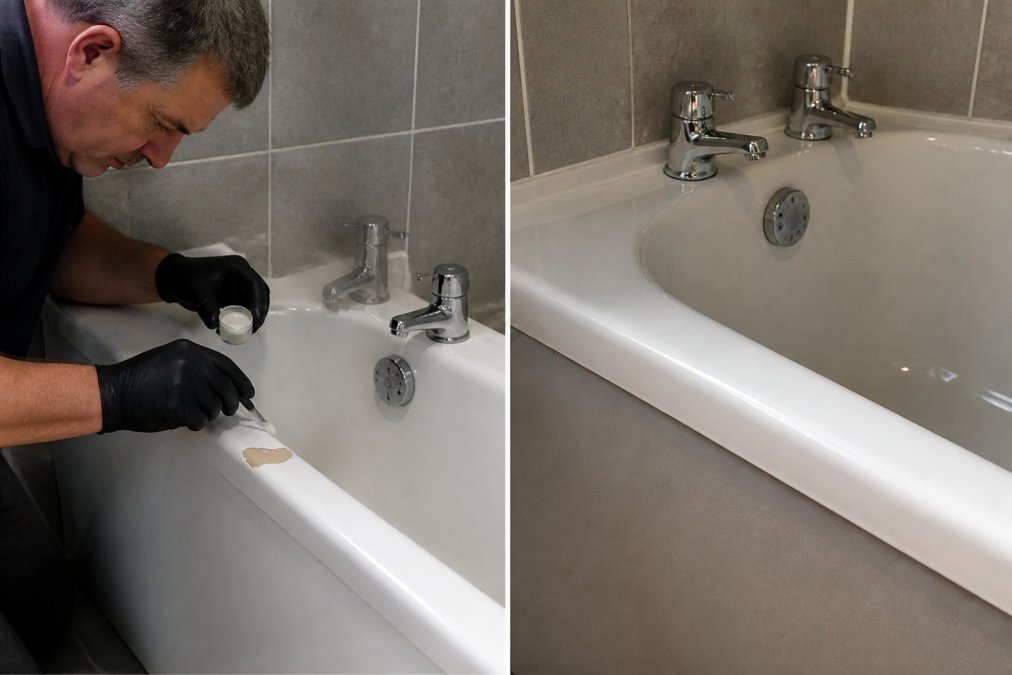
Surface Magic Repairs specialises in this assessment and repair. The team works in situ using specialist filling, colour-matching, and refinishing techniques to restore damaged surfaces. Surfaces repaired include baths, shower trays, sinks, ceramic and porcelain tiles, laminate and solid-surface worktops, UPVC window frames, doors, brickwork, and fitted furniture.
Not every surface is repairable to an invisible standard. Results depend on the material, finish, damage extent, and surrounding pattern. A professional assessment will tell you quickly whether repair is viable, and costs far less than full replacement.
Which Surfaces Can Be Repaired Rather Than Replaced?
Many hard surfaces homeowners assume are beyond saving can be repaired with the right techniques.
- Baths and shower trays: Chips, cracks, scratches, and staining on acrylic, fibreglass, enamel, and stone resin surfaces are commonly repairable.
- Ceramic and porcelain tiles: Individual cracked or chipped tiles can often be repaired without disturbing surrounding tiles or grout.
- Laminate and solid-surface worktops: Burns, deep scratches, and impact damage are frequently repairable using specialist filling and colour-matching.
- UPVC frames and doors: Scratches, dents, and discolouration can be addressed without replacement.
- Brickwork and stone: Spalling, chips, and mortar damage are repairable in many cases.
Structural damage requires different treatment. But for the vast majority of surface damage in domestic renovation, repair is the smarter first step.
2. Plan Material Quantities Accurately Before Work Begins
Accurate material planning is one of the most practical ways to reduce construction waste. Over-ordering is common in home renovation, but it is not inevitable.
A 10% contingency is appropriate for straightforward rectangular rooms with few cuts. Rooms with alcoves, angles, or complex patterns may need 15%. Ordering 25% extra "just in case" generates substantial waste and cost for no reason.
Practical steps that reduce over-ordering:
- Measure twice, calculate once. Use actual room dimensions and account for grout joint widths.
- Use a material calculator. Many tile and flooring suppliers provide online calculators that account for room shape, tile size, and laying pattern.
- Order in batches where possible. For multi-phase projects, order materials for each phase separately to reduce surplus from early phases.
- Keep a record of batch numbers. Matching batch numbers ensures consistency and avoids waste from mismatched surplus.
The same principle applies to adhesive, grout, filler, and paint, which are frequently over-purchased and then expire or harden.
3. Source Reclaimed and Surplus Materials
Sourcing reclaimed and surplus materials reduces construction waste at a systemic level. Every reclaimed brick, slate, or length of timber used is one that does not need to be newly manufactured and does not go to landfill.
The market for reclaimed materials has matured considerably. Several established suppliers operate across the UK, offering materials suitable for period property restoration to contemporary new builds.
Whitford Reclamation, based in Worcestershire, specialises in reclaimed bricks, natural stone, roofing materials, sleepers, and paving, with nationwide delivery available. Their stock suits period restoration projects and barn renovations where authentic materials make a genuine difference.
The Reclaimed Timber Company offers reclaimed timbers including Victorian floorboards, alongside bespoke furniture design and listed building renovation services. Reclaimed timber often performs better than new equivalents because it has already stabilised over decades of use.
For smaller quantities, the Sustainability Yard app connects tradespeople and DIYers who want to buy, sell, or give away surplus building materials. It is free to use and works particularly well for offloading smaller quantities that would otherwise go to waste.
WRAP's guidance on construction material reuse provides a useful framework for identifying which materials have the strongest case for reuse or reclamation.
4. Recycling Construction Materials in the UK
Recycling construction materials is the appropriate route for materials that cannot be reused directly but still have value as a resource. Most local authority household waste recycling centres accept a range of construction materials from domestic projects, though there are often limits on quantities and restrictions on trade waste. Check your local council's website before loading a vehicle, as policies vary between authorities.
What Can and Cannot Be Recycled
Commonly recyclable construction materials:
- Concrete and masonry (collected by specialist recyclers and crushed for aggregate)
- Metals including copper pipe, steel, and aluminium (scrap metal dealers accept these)
- Timber in clean condition (some recyclers and biomass facilities accept untreated wood)
- Plasterboard (must be kept separate, plasterboard recycling is available through specialist facilities)
- Cardboard and paper packaging from materials
Materials requiring specialist disposal:
- Asbestos-containing materials (requires a licensed contractor)
- Fluorescent tubes and electrical items (covered by WEEE regulations)
- Paints, adhesives, and solvents (classified as hazardous waste)
- Plasterboard mixed with other waste (contamination prevents recycling)
5. Donate or Sell Leftover Building Materials
Leftover building materials represent an opportunity to reduce construction waste while recovering project costs or doing something useful with what remains.
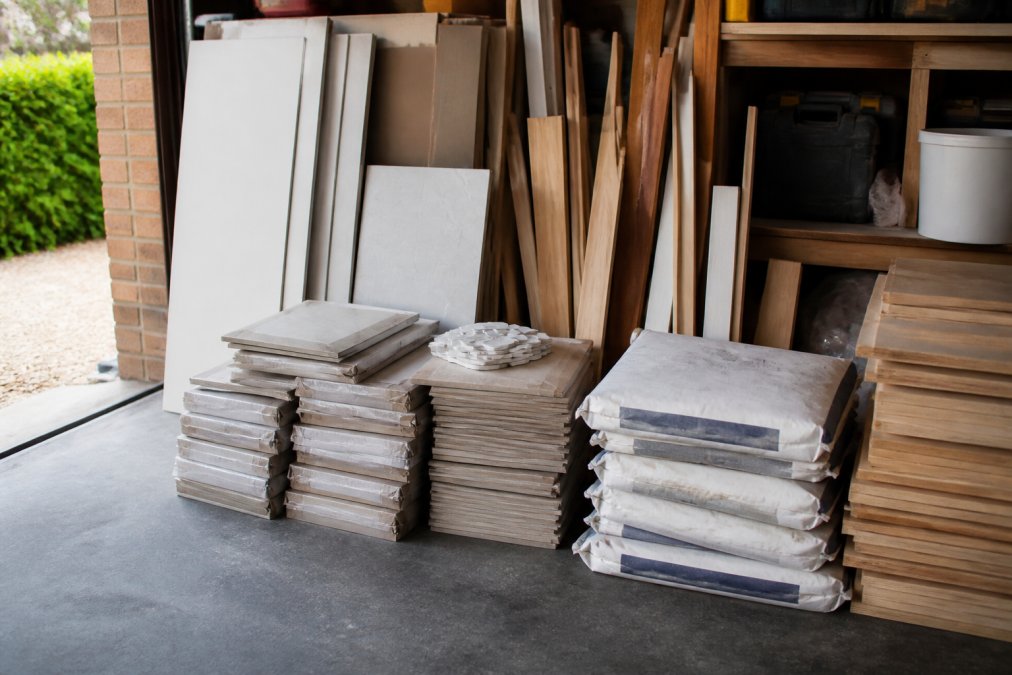
Habitat ReStore operates non-profit home improvement stores across Great Britain, accepting donations of new and gently used building materials, furniture, and home decor. Donated items are sold at reduced prices, with revenue supporting Habitat for Humanity's affordable housing mission. This is particularly good for doors, windows, sanitaryware, and kitchen units in reasonable condition.
The Rebuild Site CIC collects surplus and nearly-new construction materials from sites and makes them available to community groups, charities, and the public at reduced prices. Based in Carlisle, their model is a useful reference for similar community reuse organisations across the UK.
The Sustainability Yard app is the most convenient route for smaller quantities. You photograph and list surplus materials, set a price or offer them free, and arrange collection directly with the buyer.
For larger quantities of quality materials, Gumtree and Facebook Marketplace remain effective. Unused sanitaryware, kitchen units, and flooring sell reliably when priced sensibly and photographed clearly.
6. How to Dispose of Renovation Waste Legally and Responsibly
Disposing of renovation waste correctly is a legal requirement. The duty of care for waste in England and Wales, established under the Environmental Protection Act 1990, applies to anyone who produces, carries, or disposes of controlled waste, which includes household renovation waste.
You cannot leave renovation waste at the roadside, dump it in a public space, or hand it to an unregistered carrier. Fly-tipping carries significant penalties, and householders who use unlicensed carriers can be held responsible for how their waste is ultimately disposed of.
According to the Environment Agency's waste carrier registration guidance, any business that transports waste must be registered as a waste carrier. Always ask for proof of registration before handing waste to any third party.
Skip Hire, Waste Carriers and Duty of Care
Skip hire is the most common route for larger volumes of renovation waste from domestic projects.
- Choose a registered waste carrier. When selecting a skip hire provider, ensure they are a registered waste carrier and comply with environmental regulations. They typically offer various skip sizes.
- Separate materials where possible. Mixed waste skips are more expensive to process and less likely to result in recycling. Separating plasterboard, metals, and timber can reduce disposal costs and environmental impact.
- Check whether you need a permit. Placing a skip on a public road requires a permit from your local council. Skips on private property do not require a permit but must be clearly marked if near a road.
- Get a waste transfer note. When your skip is collected, you should receive a waste transfer note. Keep this for at least two years as evidence of compliant disposal.
For smaller quantities, your local household waste recycling centre is often the most straightforward option.
7. Reduce Construction Waste by Choosing Durable, Repairable Finishes
Decisions made at the specification stage have longer-term impact on construction waste than almost anything else. Choosing durable, repairable finishes means that when damage occurs, your options are not limited to full replacement.
Practical considerations when specifying finishes:
- Solid-surface and cast materials (solid-surface worktops, enamel baths, stone resin shower trays) are generally more repairable than thin laminates or low-density composites.
- Porcelain and ceramic tiles can be individually replaced or repaired when cracked, provided spare tiles from the original batch are retained.
- UPVC and powder-coated surfaces can be colour-matched and refinished by a specialist, avoiding full replacement.
- Avoid surfaces where a single damaged element forces replacement of the whole. Integrated worktops with no join options mean a burn mark necessitates replacing the entire run.
According to WRAP's guidance on sustainable design and material specification, designing for durability and repairability is one of the most effective strategies for reducing whole-life material consumption in buildings.
Surface Magic Repairs has completed over 46,000 surface repairs in the last year, working across domestic and commercial properties on this principle: that a surface worth repairing is a surface worth keeping. The range of materials and finishes the team can address reflects how broadly the repair-first approach can be applied when the right specification decisions have been made.
Home renovation generates waste that most people accept as inevitable. It is not. Surface Magic Repairs works with homeowners, landlords, and contractors to demonstrate that repairing damaged hard surfaces, baths, tiles, worktops, UPVC, and more, is frequently faster, cheaper, and less disruptive than replacement, and avoids sending serviceable materials to landfill. With repairs completed in situ, colour and finish matched to the existing surface, and a track record of over 46,000 repairs completed in the last year, the team is well placed to assess whether repair is viable for your project. Get an instant quote from Surface Magic Repairs and find out whether your surface needs replacing at all.
Frequently Asked Questions
How do I dispose of construction waste legally at home?
Householders have a duty of care under the Environmental Protection Act 1990 to ensure their waste is handled responsibly. You must use a licensed waste carrier to remove renovation waste, or take it to a registered household waste recycling centre yourself. Fly-tipping is a criminal offence carrying fines up to £50,000. Check that any skip hire company holds a valid waste carrier licence registered with the Environment Agency before booking.
Do I need a waste carrier licence for DIY home renovation waste?
Private householders are exempt from needing a waste carrier licence when transporting their own domestic waste to a licensed tip or recycling centre. However, if you hire a contractor or skip company to remove waste on your behalf, they must hold a valid upper-tier waste carrier licence issued by the Environment Agency. Always ask for proof of registration before handing over any materials or waste.
Can I recycle old tiles and worktops instead of skipping them?
Ceramic and porcelain tiles can be taken to household waste recycling centres, where they are typically processed as hardcore or aggregate. Laminate worktops are harder to recycle and often go to landfill, but solid-surface and timber worktops may be accepted by reclamation yards. Before skipping anything, check whether a local reuse charity, such as a Habitat ReStore or a community materials exchange, can take the items intact.
What is the most effective way to reduce waste during a kitchen renovation?
Accurate material planning is the single biggest factor. Measure twice and order to exact quantities, allowing only a small allowance for cuts. Before stripping out existing units or worktops, assess whether cosmetic repairs to chips, burns or scratches could extend their life instead. Donate intact cabinets and appliances rather than skipping them. Source any additional materials from reclamation yards or surplus material platforms to avoid generating new production waste.
How can I donate leftover building materials in the UK?
Several routes exist for donating surplus materials. Habitat ReStore accepts new and gently used building materials, furniture and home décor at locations across Great Britain. The Rebuild Site CIC in Carlisle collects surplus construction materials for community groups. Apps such as Sustainability Yard connect tradespeople and DIYers who want to give away or sell excess stock. Local Facebook Marketplace listings and Freecycle groups are also practical options for smaller quantities.
This article was written using GrandRanker