Table of Contents
- Why Disposing of Renovation Rubble Needs a Plan
- Local Council Waste Recycling Centres: What You Can Take
- Skip Hire Alternatives UK Homeowners Should Know
- Traditional Skip Hire: When It Still Makes Sense
- Reusing and Rehoming Materials Before You Bin Them
- Waste Carrier Licences and Your Legal Responsibilities
- Hazardous Renovation Waste: What Needs Special Handling
- Reducing Rubble at Source: Repair Instead of Replace
- Frequently Asked Questions
Last Updated: September 28, 2026
Why Disposing of Renovation Rubble Needs a Plan
A stripped-out bathroom or kitchen can produce more waste than most people expect, and the best ways to dispose of renovation rubble depend on volume, weight and what the material actually is. This guide from Surface Magic Repairs breaks down every realistic option, from council tips to grab hire.
Rubble is heavy. A single square metre of broken tiles or plasterboard can weigh far more than it looks, which is why the method you choose matters as much as the cost. Get it wrong and you are left with a pile in the front garden and a skip permit you did not apply for.
Below, we compare the main routes, explain the rules that catch people out, and show where avoiding replacement altogether removes the problem at source.
Local Council Waste Recycling Centres: What You Can Take
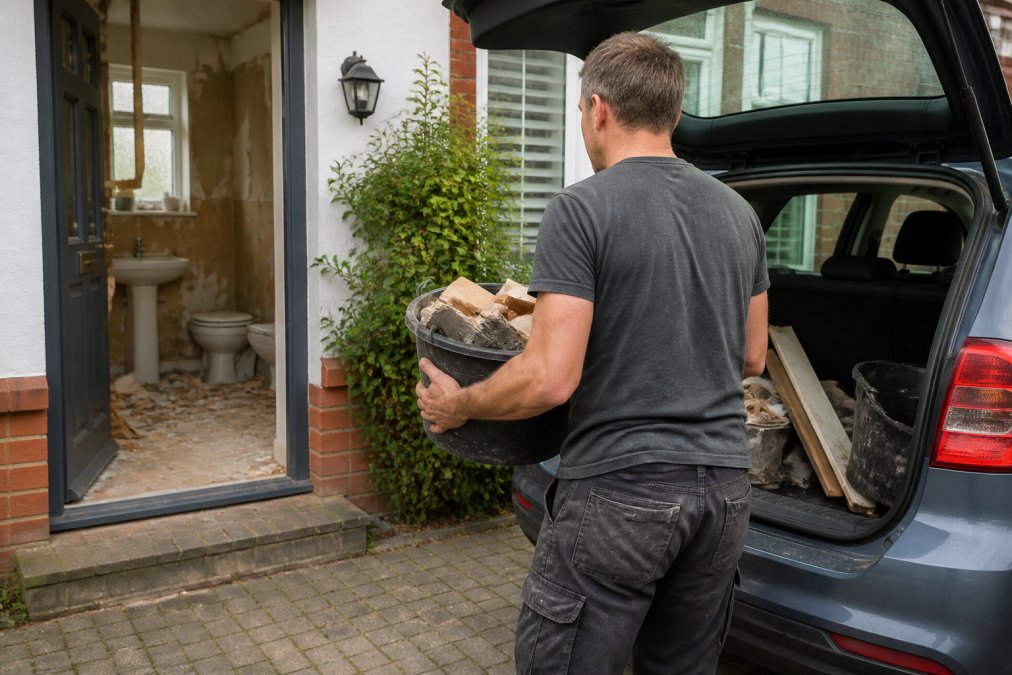
Household waste recycling centres are the cheapest route for small volumes, but they are not a free-for-all. Most councils accept rubble, timber, metal and ceramics from residents, usually free within a set weight or bag limit.
The catch is that rules vary by council. Some count bags, others weigh the load, and many restrict how many visits you can make in a year.
What most guides miss is that the material has to be separated. Rubble goes in one bay, timber in another, plasterboard often in a third. Turning up with a mixed trailer usually means being turned away.
Check your council's site rules before you load the car. A quick look at GOV.UK's find your local council tool will point you to the right authority and its waste pages.
Weight Limits and Permit Rules to Check Before You Go
Weight limits are where DIYers get caught out. A typical car boot load of tiles is fine; a trailer stacked with concrete is not.
- Vans and trailers usually need a permit, booked in advance
- Some sites ban vans entirely without proof of residency
- Plasterboard is often limited to a few sheets per visit
- Commercial waste is refused, even if you produced it yourself
If you are renovating a rental property rather than your own home, the waste is classed as commercial and the tip will not take it. That single distinction changes which options are open to you.
Skip Hire Alternatives UK Homeowners Should Know
Skip hire is not the only way to clear a site. Several skip hire alternatives UK homeowners use are cheaper, faster or simply more practical when there is nowhere to put a metal container.
The main options are HIPPOBAGs, grab hire and man-and-van services. Each suits a different situation.
| Method | Best For | Key Advantage | Main Drawback |
|---|---|---|---|
| HIPPOBAG | Small to medium projects | Fill at your own pace | Weight limits apply |
| Grab hire | Large loose piles | No skip permit needed | Needs lorry access |
| Man-and-van | No loading ability | Labour included | Pricier per cubic metre |
| Skip hire | Heavy mixed waste | Holds bricks and concrete | Needs space and a permit |
HIPPOBAGs, Grab Hire and Man-and-Van Services Compared
A HIPPOBAG is a heavy-duty bag you fill over days or weeks, then book for collection. It suits slow renovations where a skip would sit idle and rack up hire charges.
Grab hire sends a lorry with a hydraulic arm that lifts loose rubble over walls and fences. It is ideal when a skip cannot be placed, but the lorry needs clear access and the waste must be loose, not bagged.
Man-and-van services remove the labour problem entirely. You point, they carry. Expect to pay more per load for the convenience, and check the operator holds a waste carrier licence.
Traditional Skip Hire: When It Still Makes Sense
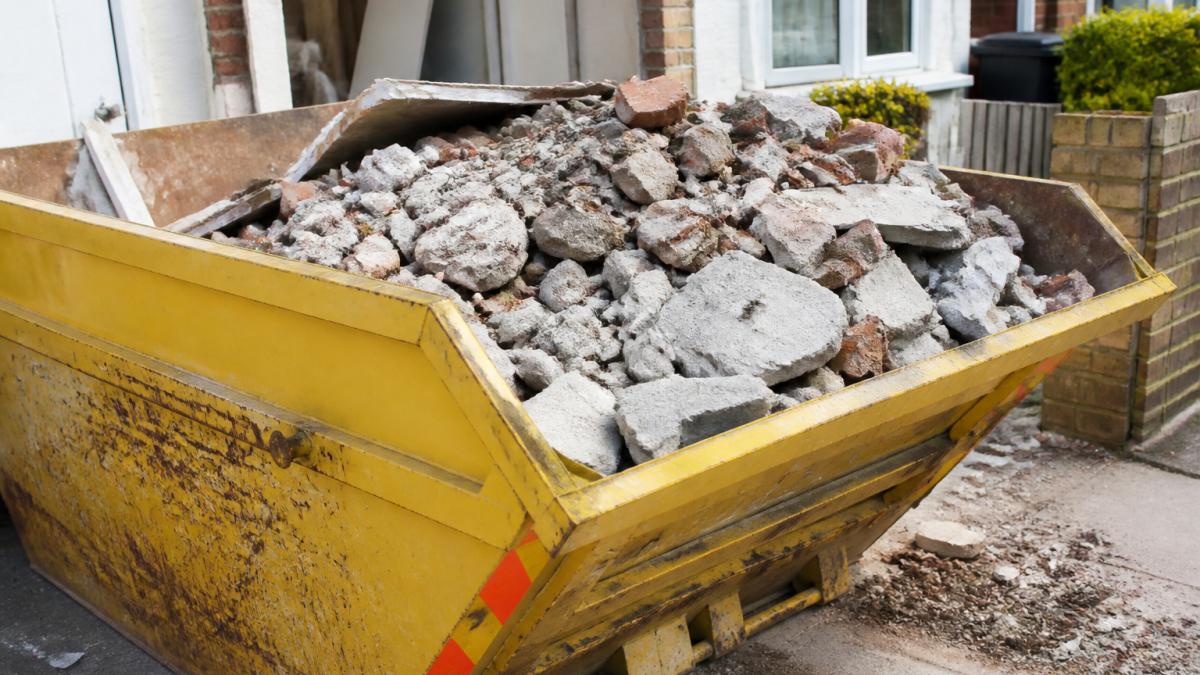
Skip hire remains the default for medium to large jobs, and for good reason. A skip sits on site, takes mixed heavy waste without sorting, and one delivery covers the whole project.
It makes sense when you have bricks, concrete, soil and timber all coming out at once. The container holds weight that bags and vans cannot.
The drawbacks are real, though. You need off-road space, or a permit from the council for a skip on the highway. Skips also invite neighbours to add their own rubbish when you are not looking, which can push you over the weight limit.
If access is tight, a skip simply will not fit. That is when grab hire or a bag service wins.
Reusing and Rehoming Materials Before You Bin Them
Not everything in a skip needs to be there. Usable materials have value, and rehoming them costs nothing while cutting your disposal volume.
Whole tiles, timber offcuts, doors, sinks and lengths of copper all find takers. Platforms such as Freecycle and Facebook Marketplace list them for free, and there is usually someone within a few miles who wants them.
Broken brick and concrete, known as hardcore, is often wanted for landscaping and driveways. Listing it as free collection saves you the tip run entirely.
Be realistic about what people will take. Broken plasterboard and mixed rubble rarely attract interest. Sort the good from the genuinely useless before you advertise anything.
Waste Carrier Licences and Your Legal Responsibilities
Your duty of care for waste does not end when it leaves your property. If you pay someone to take rubble away, you are responsible for checking they are allowed to carry it.
In England, anyone transporting waste as part of a business must be registered with the Environment Agency (Register or renew as a waste carrier, broker or dealer). You can check a carrier's registration through the Environment Agency's public register.
Ask for a waste transfer note. It records what was taken, when, and by whom, and it is your proof that you disposed of the waste correctly.
This applies to homeowners as much as businesses. Skip hire firms, grab hire operators and man-and-van services should all be able to show registration without hesitation.
Hazardous Renovation Waste: What Needs Special Handling
Some renovation waste cannot go in a skip at all. Asbestos is the big one, and it turns up in older properties more often than people expect.
Materials such as old floor tiles, pipe lagging, cement sheets and some textured coatings may contain asbestos. These need specialist removal by a licensed contractor, not a trip to the tip.
Other items needing separate handling include:
- Paint tins with liquid paint still inside
- Solvents, adhesives and sealants
- Some sealants and mastics
- Fluorescent tubes and old light fittings
- Plasterboard, which releases hydrogen sulphide in landfill
Plasterboard is a common trap. Many tips accept it only in small quantities and separately from other waste, so check before you load.
Reducing Rubble at Source: Repair Instead of Replace
The most effective way to cut renovation rubble is to avoid creating it. Repairing a damaged surface in place means nothing gets ripped out, and nothing gets disposed of.
A chipped bath, a cracked shower tray, a scratched worktop or a burnt laminate surface can often be restored rather than replaced. That removes the old unit from the waste stream entirely and avoids the knock-on rubble from tiling, sealing and making good.
This is where Surface Magic Repairs comes in. The company repairs chips, cracks, burns, dents and scratches to baths, shower trays, sinks, worktops, tiles, uPVC frames, doors and fitted furniture, completing the work on site with colour and finish matching. More than 46,000 surfaces were repaired in the last year alone.
Suitability depends on the material, the condition and how far the damage goes. An honest assessment comes first, and if replacement is genuinely the better option, Surface Magic Repairs will say so.
For landlords, hoteliers and property managers, the effect is immediate. No strip-out, no skip, no room out of action for days. A repair is typically completed in a single visit.
Every renovation eventually produces something that has to go, and getting rid of it legally and cheaply takes a bit of planning. Before you book a skip, check whether the damaged item actually needs replacing at all. Surface Magic Repairs restores baths, shower trays, worktops, tiles, doors and furniture in place, with colour-matched finishes, minimal disruption and no strip-out. Send clear photographs of the damage, the complete item and the surrounding area, along with your full address and postcode, to info@surfacemagicrepairs.com or call 0800 085 7773, and the team will assess whether a repair is suitable and provide a quotation.
Frequently Asked Questions
Can I take renovation rubble to my local council tip?
Most local council waste recycling centres accept small quantities of renovation rubble from residents, usually free of charge within set weight limits. You will need to check your council's specific rules, as some require proof of address or restrict DIY waste to certain amounts per visit. Larger volumes or waste from commercial work may be refused or charged for. Always check before loading your vehicle to avoid a wasted trip.
What is the most cost-effective way to remove building waste?
For small amounts of rubble, local council waste recycling centres are usually the cheapest option because they are free for residents within weight limits. For larger volumes, skip hire or grab hire can work out more economical per tonne, though pricing depends on your location, access and the type of waste. If you have usable materials, listing them on Freecycle or Facebook Marketplace can remove them at no cost. Always get a quote based on your specific job.
Do I need a waste carrier licence to move my own renovation rubble?
If you are a homeowner transporting your own renovation waste to a licensed disposal site, you generally do not need a waste carrier licence. However, if you are a tradesperson or business removing waste as part of your work, you will need to register as a waste carrier with the Environment Agency. Anyone hiring a third party to remove waste should check they hold a valid licence and request a waste transfer note for compliance.
Are there alternatives to hiring a skip for small amounts of rubble?
Yes, there are several skip hire alternatives UK homeowners can use for smaller jobs. HIPPOBAGs are heavy-duty bags collected on demand, ideal when you have limited space. Man-and-van services will load and remove debris for you. Grab hire lorries can lift loose rubble over walls or fences without needing a skip permit. For very small amounts, your local council recycling centre may be the simplest and most cost-effective option.