Table of Contents
- Why Surface Repair Creates Far Less Disruption Than Replacement
- The Repair Versus Replace Cost Analysis for Construction Managers
- Keeping Daily Operations Moving with On-Site Repairs
- Managing Snagging in Occupied Buildings Without Evacuations
- Accelerating New-Build Snagging Repairs for Faster Handovers
- How Long Do In-Situ Repairs Take?
- What to Send for a Disruption-Free Quotation
- Conclusion: Repair in Place to Protect Your Schedule
- Frequently Asked Questions
Last Updated: September 8, 2026
Why Surface Repair Creates Far Less Disruption Than Replacement
Construction disruption is the hidden cost that rarely appears on a quote, and this construction disruption is what in-situ repair eliminates. When a damaged bath, worktop or tile is stripped out and replaced, the true price is not just the new unit. It is the downtime, the access arrangements, the knock-on trades and the schedule slip that follows. For construction managers and facilities teams, this is why in-situ surface repair creates far less disruption to daily operations or home life for construction management than traditional replacement.
The principle is simple: repair the damaged surface in place rather than removing the whole item. Surface Magic Repairs specialises in restoring chips, scratches, cracks, burns and impact damage to baths, shower trays, worktops, tiles, doors and uPVC frames without strip-out. The repaired area is colour matched and refinished to blend with the surrounding surface, so the item stays exactly where it is.
That single decision changes the entire programme. No plumber to disconnect the bath. No tiler to make good the walls. No joiner to refit the worktop. No skip for the old unit. The disruption that normally cascades through a project is removed at source.
The Repair Versus Replace Cost Analysis for Construction Managers
A repair versus replace cost analysis for construction managers must count more than the invoice for the new item. Replacement carries a chain of costs that are easy to miss when pricing a job. Each trade needs booking, each visit needs supervision, and each delay pushes the handover date further out.
| Cost Factor | Replacement | In-Situ Repair |
|---|---|---|
| New unit purchase | Yes | No |
| Strip-out and disposal | Yes | No |
| Plumber or joiner call-out | Yes | No |
| Tiling or decorating make-good | Often required | Rarely needed |
| Room or area downtime | Days | Hours |
| Knock-on schedule delays | High risk | Minimal |
The commercial case rests on this contrast. Repairing in place avoids the need for knock-on decorating or tiling work, which is frequently the most expensive and time-consuming part of a replacement. It also keeps the existing surface intact, so the surrounding finishes are undisturbed. For a hotel room, a rental property between tenancies or an occupied office, that difference is measured in usable days, not just pounds.
Cost still depends on the surface, the damage, location, access and the number of repairs needed. Sending clear photographs allows an honest assessment before any work is booked, so there are no surprises on site.
Keeping Daily Operations Moving with On-Site Repairs
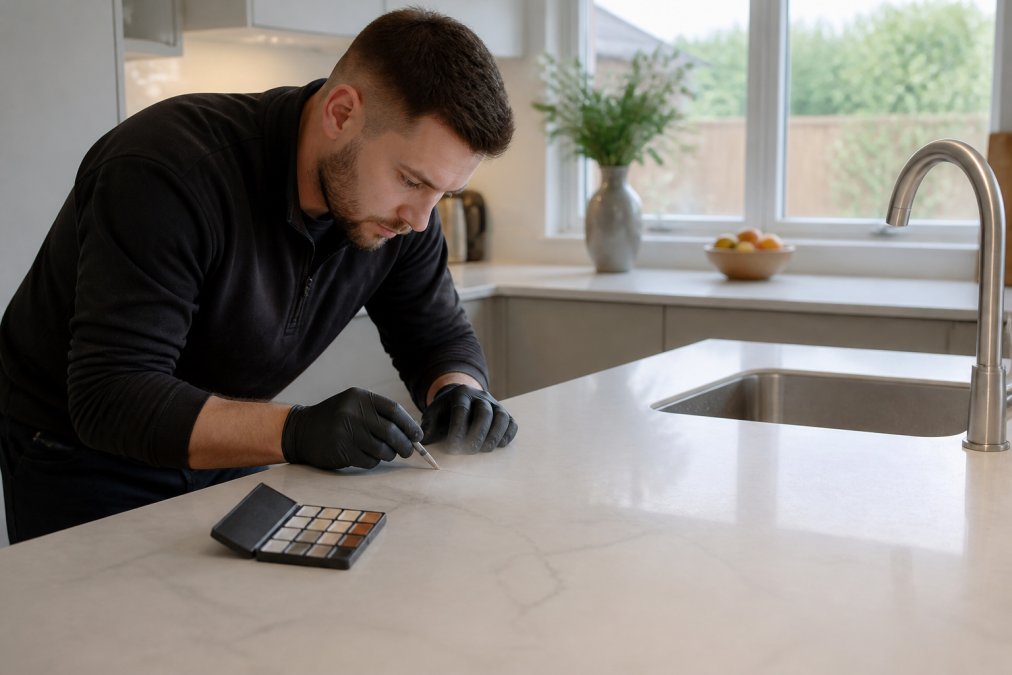
The practical advantage of on-site repair is that life continues around it. A technician arrives with the materials needed to fill, rebuild, colour match and refinish the damaged area. There is no requirement to move furniture out, isolate water supplies or close a room for days.
For a hotel, keeping a room out of action while a bath is stripped and retiled can mean lost revenue that far exceeds the repair cost (ahla.com). For a care home or healthcare environment, disruption to residents is a serious concern. For a retail premises, closing for works is rarely acceptable. In-situ repairs answer all of these because the work is contained, quiet and completed quickly.
This is where the phrase far less disruption to daily operations or home life for construction management becomes concrete. A guest room can often be back in service the same day. A rental property can be turned around between tenancies without a long void. An office can keep operating while a damaged worktop or panel is restored.
The team at Surface Magic Repairs works alongside site managers, maintenance teams and other contractors, so the repair is coordinated with the wider programme rather than competing with it.
Managing Snagging in Occupied Buildings Without Evacuations
Managing snagging in occupied buildings presents a particular challenge. Residents, guests or staff are already in place, and the usual assumption is that rectifying damage means moving people, closing areas and accepting disruption. That assumption is often wrong.
Cosmetic snagging damage, such as a chipped bath, a scratched worktop or a dented panel, can be repaired in situ without evacuating the room or the building. The technician prepares the damaged area, rebuilds or fills it, reproduces the colour, texture or pattern and applies a suitable finish. The work is contained to the damaged spot, not the whole room.
For student accommodation, build-to-rent operators and housing associations, this is a significant advantage. Repairs can be scheduled around occupancy rather than forcing a void. For facilities-management companies maintaining occupied offices, the ability to repair without closing a floor keeps daily operations running.
This approach also supports planned surface-repair programmes across property portfolios. Instead of reacting to each damaged item as a separate emergency, a coordinated visit can address multiple repairs across different units, reducing the number of site attendances and the cumulative disruption.
Accelerating New-Build Snagging Repairs for Faster Handovers
New-build snagging repairs are a bottleneck on many construction sites. The building is finished, the customer-care team is working through the defect list, and every outstanding item delays the handover. Surface repairs are often the quickest items to clear, yet they can sit unresolved if they require a replacement that needs ordering and fitting.
In-situ repair changes that timeline. A damaged worktop, a chipped sink or a scratched door can often be restored on the same visit, with no lead time for a replacement unit. The repair is completed in place, the area is refinished to match, and the snag is closed. This accelerates the path to handover and keeps the programme moving.
For housebuilders, property developers and main contractors, the benefit is a faster route to completion and fewer hold-ups in the customer-care phase. The Surface Magic Repairs team can assess multiple damaged surfaces across different units in a single site visit, so the snagging list is worked through efficiently rather than job by job.
The key is to assess each item honestly. Suitability depends on the material, condition, location and extent of the damage. Where replacement would genuinely be more appropriate or durable, that advice should be given clearly rather than forcing a repair that will not last.
How Long Do In-Situ Repairs Take?
Most in-situ surface repairs are completed within a few hours, depending on the material and the extent of the damage (thisoldhouse.com). A small chip on a bath or sink can often be finished in under an hour. A larger repair, such as a burn on a laminate worktop or a crack in a shower tray, may take longer because the filling, colour matching and finishing need careful layering.
| Repair Type | Typical Duration | Downtime Impact |
|---|---|---|
| Small bath or sink chip | Under an hour | Minimal |
| Shower tray crack or chip | 1-2 hours | Room usable same day |
| Laminate worktop burn or scratch | 1-3 hours | Kitchen usable same day |
| Multiple snagging items on site | Half to full day | Coordinated around programme |
The finish may need time to cure before the surface is back in full use, and the technician will advise on this. The important point is that the room or area is not out of action for days while a replacement is stripped out and fitted.
This speed is what makes in-situ repair so valuable in time-sensitive environments. A hotel with guests checking in tomorrow, a landlord with a tenancy starting Monday, or a site manager with a handover deadline can all work around a repair that takes hours, not days.
What to Send for a Disruption-Free Quotation
Getting an accurate quotation without a site visit starts with good photographs. The clearer the pictures, the more precise the assessment. Send photographs of the damage itself, the complete item it sits on, and the surrounding area so the technician can see the context.
Include your full address and postcode so availability can be checked for your location. Surface Magic Repairs is based in Bolton and covers Greater Manchester as standard, with wider North West and scheduled national coverage for suitable commercial and multi-site projects. For domestic work further away, sending the postcode allows the team to confirm whether a visit is economical.
The photographs should show the type of damage, whether it is a chip, scratch, crack, burn or dent, and the material involved. This allows an honest assessment of whether the surface is suitable for repair or whether replacement would be more appropriate. Not every surface can be repaired, and a professional team will say so clearly.
Send the details to Surface Magic Repairs and the team can assess the damage and provide a quotation, usually from photographs alone. Call 0800 085 7773 or visit surfacemagicrepairs.co.uk to get the process started.
Conclusion: Repair in Place to Protect Your Schedule
The case for in-situ surface repair is built on protecting what matters most on any project: the schedule and the people using the building. Far less disruption to daily operations or home life for construction management is not a marketing phrase. It is the practical outcome of repairing damaged surfaces in place rather than replacing them.
Replacement carries hidden costs in downtime, knock-on trades and delayed handovers. Repair removes those costs at source. The Surface Magic Repairs team has completed more than 46,000 surface repairs in the last year, combining more than 25 years of trade experience with the accreditations that construction clients expect, including ISO 9001, CHAS Premier, SMAS Worksafe and SafeContractor approval (iso.org).
Send clear photographs of the damage, the complete item and the surrounding area, together with your full address and postcode. Surface Magic Repairs can assess whether a repair is suitable and provide a quotation. Get started and keep your project moving.
Frequently Asked Questions
How can construction managers reduce disruption during renovation projects?
Plan repairs in phases and choose in-situ methods wherever possible. Removing and replacing a damaged worktop or bath involves strip-out, plumbing changes and re-tiling, which can take days. A specialist surface repair is completed on site in a single visit, so rooms stay operational and trades are not held up waiting for replacement parts. Send clear photographs and job details before booking to confirm the repair is suitable.
What are the benefits of on-site surface repair versus full replacement?
On-site repair keeps the existing fixture intact, which avoids the cost of a new unit, delivery lead times, and the labour for removal and installation. There is no knock-on decorating or tiling work, and the area can often be used again the same day. For construction managers, this means fewer programme delays and less waste heading to landfill, which supports sustainability targets on new-build and refurbishment projects.
How does surface repair help with new-build snagging?
New-build snagging repairs address chips, scratches and dents found during the pre-handover inspection. Specialist technicians can repair damaged worktops, baths, shower trays, doors and tiled surfaces in place, often while other trades are still finishing nearby areas. This avoids the delay of ordering replacements and prevents snagging items from holding up the handover of whole units to the client or new homeowner.
Can damaged kitchen worktops and baths be repaired in occupied properties?
Yes, most cosmetic damage to worktops, baths and shower trays can be repaired in occupied homes, hotel rooms or offices. The technician works within a contained area using specialist fillers and coatings, so there is no need to disconnect plumbing or move heavy items. Suitability depends on the material and extent of the damage, so send photographs first for an honest assessment before any work is booked.