Table of Contents
- DIY vs Professional Repair for New Build Surfaces: The Short Answer
- Which New Build Surfaces Are Commonly Repaired?
- DIY Repair vs Professional Repair: Side-by-Side Comparison
- The Real Pros and Cons of DIY Surface Repair
- The Real Pros and Cons of Professional Surface Repair
- Repair or Replace Damaged New-Build Surfaces: How to Decide
- New-Build Snagging Repairs: Why the First Fix Matters
- Surface Repair Quotation Photographs: What to Send
- When Professional Repair Is the Sensible Choice
- Frequently Asked Questions
Last Updated: 20 October 2026
DIY vs Professional Repair for New Build Surfaces: The Short Answer
DIY vs professional repair for new build surfaces comes down to one question: can you match the finish? Cosmetic repairs on new build surfaces are judged against a flawless standard, because everything around the damage is brand new. A filler that sits slightly proud, a colour that reads a shade too dark under daylight, or a texture that catches the light differently will be spotted immediately on a handover inspection.
At Surface Magic Repairs, we assess damaged baths, worktops, tiles, doors and uPVC frames every week on sites across the North West. Our honest view: small, hidden, low-visibility damage is sometimes a sensible DIY job. Anything visible, anything on a warranty-critical surface, and anything that will be inspected by a buyer or site manager is not.
Below, we break down which new build surfaces are commonly repaired, where DIY holds up, where it fails, and how to decide. The short answer table first:
| Situation | Better option | Why |
|---|---|---|
| Chip in a hidden cupboard interior | DIY | Low visibility, low risk |
| Scratch on a visible worktop edge | Professional | Colour and sheen must match |
| Cracked shower tray | Professional | Water integrity and safety |
| Small scuff on a painted door | Either | Assess visibility first |
| Bath chip in a show home | Professional | Inspected under bright light |
| Damaged tile in a tiled run | Professional | Pattern and grout line matching |
Which New Build Surfaces Are Commonly Repaired?
The surfaces that come up most often on new build snagging repairs are the ones installed last and handled most: sanitaryware, worktops, tiles, doors and window frames. Damage usually happens between installation and handover, when trades are still moving through.
The common candidates:
- Baths and shower trays - chips, scuffs and hairline cracks from tools, tiles or boots
- Kitchen worktops - chips on laminate and solid-surface edges, burns, scratches
- Tiles - chipped corners and cosmetic cracks in ceramic and porcelain
- uPVC window frames and cills - scratches and scuffs from plasterers and renderers
- Doors and door frames - dents, impact damage and paint loss
- Sinks and sanitaryware - chips around wastes and overflows
- Fitted furniture and cabinets - edge damage and surface scuffs
Suitability always depends on material, condition, location and extent. A hairline cosmetic crack in a tile is a very different job from a structural crack in a shower tray, and we will say so plainly.
DIY Repair vs Professional Repair: Side-by-Side Comparison
Professional repair wins on finish quality and warranty risk; DIY wins on immediate convenience for minor, low-visibility damage. That is the honest trade-off.
| Factor | DIY repair | Professional repair |
|---|---|---|
| Upfront cost | Lower materials cost | Higher, but below replacement |
| Finish matching | Hard to match colour and sheen | Colour and finish matched |
| Time to complete | Depends on skill and drying | Usually completed in place |
| Risk of making it worse | Moderate to high | Low |
| Warranty and sign-off | May be rejected on inspection | Defensible, documented |
| Disruption | Minimal | Minimal, no strip-out |
| Repeat visits | Common if finish fails | Rare when assessed correctly |
The point most guides miss is that DIY rarely fails because the filler is wrong. It fails at the colour and texture stage, which is the part that takes years to learn.
The Real Pros and Cons of DIY Surface Repair
DIY surface repair suits small, concealed damage where a perfect match does not matter. It falls apart the moment the repair is visible or inspected.
Pros of DIY:
- No waiting for a booking
- Low material cost for minor jobs
- Fine for damage inside cupboards, behind appliances or in unseen areas
Cons of DIY:
- Colour and sheen matching is genuinely difficult
- Specialist fillers and coatings behave differently from general-purpose products
- A failed repair often costs more to put right than a professional job would have cost
- No documentation for sign-off
The Real Pros and Cons of Professional Surface Repair
Professional surface repair restores the damaged area in place, with the colour, texture and finish matched to the surrounding surface. It avoids strip-out, replacement and the decorating that follows.
Pros of professional repair:
- Repairs completed in place with no removal or strip-out
- Colour and finish matched to the existing surface
- No knock-on tiling, sealing or decorating
- Fast turnaround, which matters on occupied sites and in hotel rooms
- Honest assessment before work is booked
Cons of professional repair:
- You need to book and send photographs first
- Not every surface is suitable, and we will tell you when replacement is the more durable answer
- Results depend on material, finish and the surrounding pattern, so a repair improves the area rather than guaranteeing invisibility
Repair or Replace Damaged New-Build Surfaces: How to Decide
Repair is usually the right call when the damage is cosmetic and the substrate is sound; replacement is the right call when the surface is structurally compromised or the finish cannot be matched. Use these questions in order.
- Is the damage cosmetic or structural? Cracks that affect water integrity, or damage that has moved the substrate, point to replacement.
- How visible is it? Anything in a show home, a handover inspection or a guest-facing room should be professionally finished.
- Is the item still under warranty or due for sign-off? A documented professional repair protects your position.
- What does replacement trigger? Retiling a run, resealing a bath or removing a worktop often costs far more than the item itself.
- How many repairs are there? A single repair and a snagging list of forty are different projects, and a planned visit is usually the efficient route.
New-Build Snagging Repairs: Why the First Fix Matters
New-build snagging repairs are the cosmetic defects logged before handover, and the first fix is the one that gets inspected. A repair done properly once is cheaper and faster than a repair done twice.
On a live site, timing matters as much as finish. Damage found during the final clean is the most expensive to fix, because trades have gone and access is tighter. Catching chips and scuffs earlier, and repairing them in place before handover, keeps the programme moving and avoids ripping out serviceable materials.
For housebuilders and developers, the practical advantage is simple: repairs completed in place mean no strip-out, no waiting for a replacement item, and no knock-on decorating in a plot that is nearly ready.
Surface Repair Quotation Photographs: What to Send
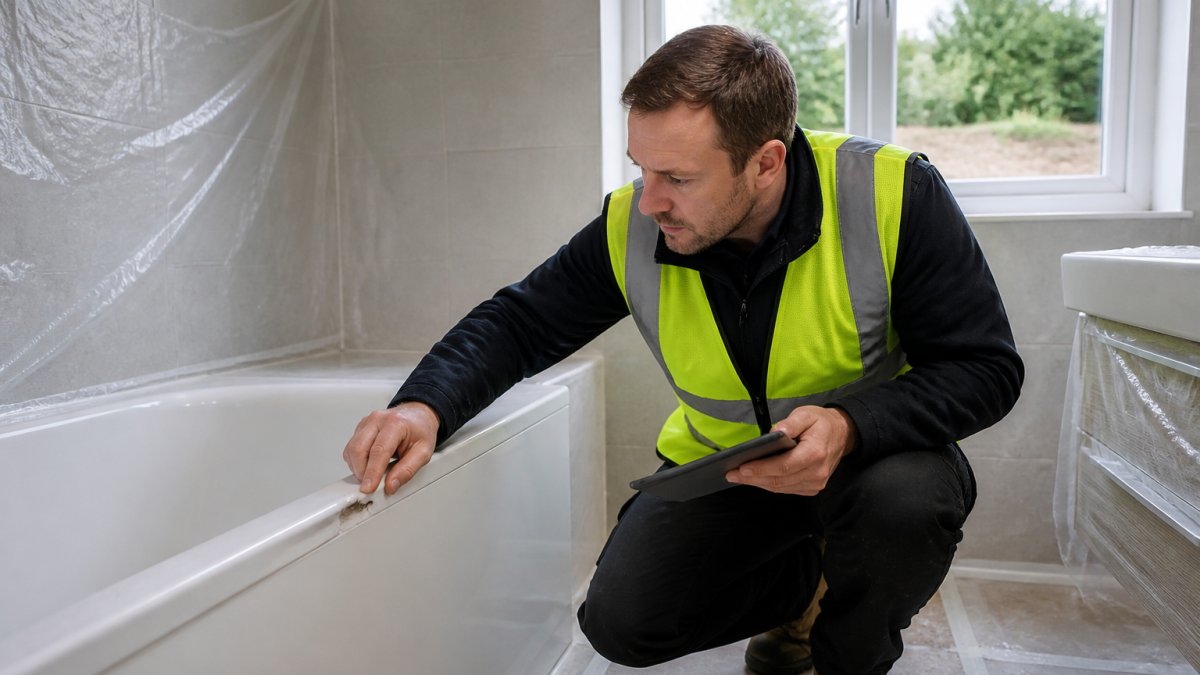
Surface repair quotation photographs are the fastest route to an accurate assessment, and most jobs can be quoted from images alone. Send three clear photographs per damaged item.
What to include:
- A close-up of the damage in good light, in focus, filling the frame
- The complete item so we can see where the damage sits
- The surrounding area so the colour, pattern and finish can be judged
Add your full address and postcode, the number of repairs, and any access notes. For commercial and multi-site work, a list by plot or room helps us plan a single visit.
When Professional Repair Is the Sensible Choice
Professional repair is the sensible choice when the surface is visible, inspected, or expensive to replace. That covers most new build damage.
Call in a specialist when:
- The damage is on a surface a buyer, guest or inspector will see
- The item is a bath, shower tray or worktop where replacement means strip-out
- The finish involves a pattern, texture or gloss level that must be matched
- You have multiple repairs across units and need one planned visit
- The repair must hold up in a busy commercial environment
Surface Magic Repairs is Bolton-based and travels across Greater Manchester and the wider North West, with nationwide work available for suitable commercial and multi-site projects. We repair in place, match the finish, and tell you honestly when replacement is the better answer. More than 46,000 surfaces were repaired in the last year, and we hold ISO 9001, CHAS Premier, SMAS Worksafe and SafeContractor Approved accreditation.
New build damage rarely waits for a convenient moment, and every day a chipped bath or scratched worktop stays on the snagging list is a day it can hold up handover or a sale. Surface Magic Repairs repairs damaged surfaces in place, with colour and finish matched to the surrounding area, no strip-out and no knock-on decorating. Send clear photographs of the damage, the complete item and the surrounding area, together with your full address and postcode, and we will assess whether a repair is suitable and provide a quotation. Call 0800 085 7773 or visit surfacemagicrepairs.co.uk to get started.
Frequently Asked Questions
Should I repair new-build surface damage myself or hire a professional?
It depends on the surface and the damage. Small, isolated marks on hard-wearing materials can sometimes be touched in with a matching filler or polish. Anything involving colour matching, texture, gloss level or a visible position is better handled by a professional. A trained technician can rebuild the damaged area, reproduce the pattern and refinish it so the repair blends with the surrounding surface. If the damage sits on a worktop, bath or tile in a prominent spot, a poor DIY repair is usually more noticeable than the original chip.
Can chips and scratches on new-build baths or worktops be repaired?
In many cases, yes. Bath chips, scratches and small cracks are routinely repaired in place, as are chips, burns and impact marks on laminate and solid-surface worktops. Suitability depends on the material, the depth of the damage and its location. A deep burn that has broken through the surface layer, or a crack that has compromised the structure, may be better replaced. A professional assessment will tell you honestly whether a repair will hold up or whether replacement is the more durable option.
When should a new-build surface defect be reported to the housebuilder?
Report defects as soon as you spot them and keep them within the relevant warranty or defects period, which is typically two years for most new-build homes. Photograph the damage before anyone attempts a repair, note the date and location, and submit it through the customer-care process. Attempting a DIY fix first can void your ability to claim, because the housebuilder may argue the damage was caused by your work. If a contractor is sent to repair it, let them assess before you touch it.
What information should I provide when requesting a surface-repair quotation?
Send clear photographs of the damage close up, the complete item and the surrounding area, so the assessor can see the material, colour and pattern. Include your full address and postcode, the number of repairs needed and any access restrictions. For multiple units or a snagging list, send one set of photos per item with a note of the plot or room. Surface Magic Repairs can assess suitability and provide a quotation from photographs before booking, which saves a site visit for straightforward jobs.