Last Updated: 24 October 2026
Quick Summary
Call a flooring specialist when the damage is localised but hard to match, when the same spot keeps failing, or when the floor feels wrong underfoot. A flooring specialist assesses, repairs and refinishes damaged floor surfaces rather than simply replacing whole boards or coverings. Cosmetic damage may suit a careful DIY kit, but springy patches, lifting seams and water staining need professional assessment.
- A hollow sound underfoot usually means the board has lifted from the subfloor.
- Laminate repair can restore chips, scratches, burns and edge damage where the board is sound.
- Swollen or delaminated boards need replacement rather than repair.
- A clear quotation should state the surface type, number of repairs and finish applied.
- Ask whether the work is done in place and what happens if the repair does not hold.
Table of Contents
- When a Flooring Specialist Is the Right Call
- The Flooring Damage Assessment: Cosmetic or Structural?
- 7 Signs Your Floor Repair Is Beyond DIY
- Laminate Flooring Repair: What a Specialist Can Realistically Fix
- Floor Repair or Replacement: How to Decide
- What a Floor Repair Quotation Should Cover
- Questions to Ask Before You Book a Flooring Specialist
- Why In-Place Floor Repairs Suit Landlords, Hotels and Site Handovers
- Send Photos of the Damage for an Honest Assessment
- Frequently Asked Questions
When a Flooring Specialist Is the Right Call
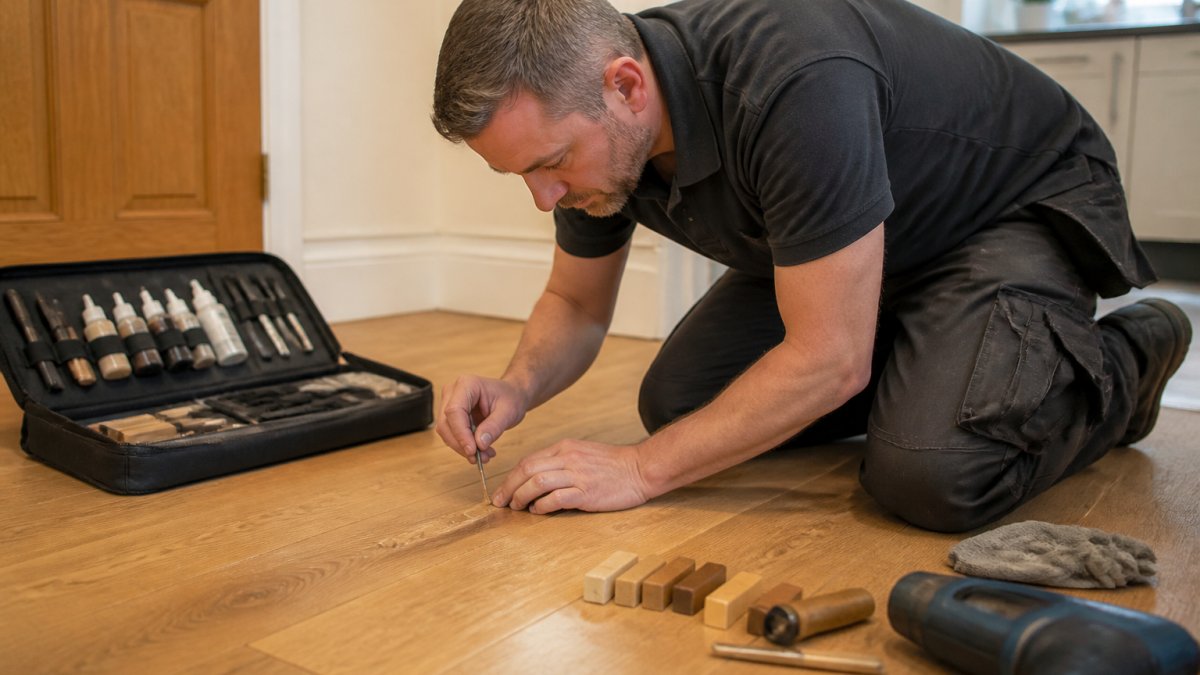
A flooring specialist is a trade professional who assesses, repairs and refinishes damaged floor surfaces rather than simply replacing whole boards or coverings. Knowing when to hire a flooring specialist for repairs usually comes down to one question: is the damage cosmetic, or has the floor started to fail?
Surface Magic Repairs deals with this decision every week. We repair finished surfaces in place, and we will say plainly when a floor needs more than a cosmetic fix.
Here is the short answer. Call a specialist when the damage is localised but hard to match, when the same spot keeps failing, or when the floor feels wrong underfoot. For a light scuff on a mid-floor board, a careful DIY kit may be fine. For a chipped edge in a doorway, a burn on a laminate worktop run or a lifting seam in a hotel corridor, it usually is not.
Below, we break down the seven signs that tell you it is time to bring someone in, plus what a quotation should cover and the questions worth asking before you book.
The Flooring Damage Assessment: Cosmetic or Structural?
A flooring damage assessment separates surface damage from movement or moisture problems. Cosmetic damage sits in the finish, the wear layer or the top few millimetres of the board. Structural damage affects how the floor performs: it moves, it holds water, or it no longer sits flat.
That distinction decides everything. A chipped laminate edge near a door threshold is cosmetic. A springy patch in the middle of a room is not.
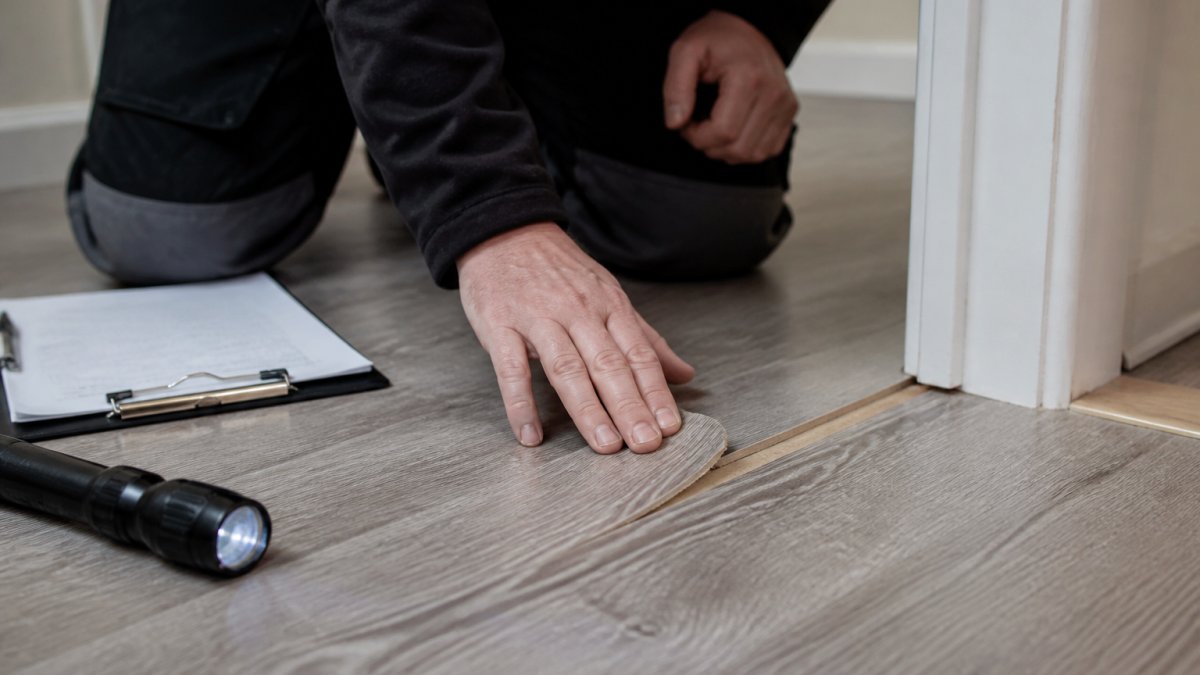
We use a simple three-part check on site:
- Look: is the damage a mark, a chip, a burn or a crack?
- Feel: does the floor move, dip or sound hollow underfoot?
- Test: does a damp meter or a moisture reading suggest water is involved?
If the answer to the last two is yes, a cosmetic repair will not hold. If you are weighing up a DIY kit against a professional visit, our guide to DIY vs professional repair for new build surfaces goes deeper on that exact decision.
7 Signs Your Floor Repair Is Beyond DIY
The seven signs are: damage that returns after repair, springy or hollow patches, damage at seams and edges, burns and deep gouges, widespread pattern or colour loss, water staining, and damage across multiple rooms or units. Any one of these is a reason to get the floor looked at properly.
Here they are in more detail, with the two most common ones pulled out below.
Damage That Keeps Coming Back
A repair that fails in the same spot is telling you something. Either the filler is not bonding to the substrate, or there is movement underneath that keeps working the repair loose.
Filling over a moving joint is a waste of time and money. The right fix is to stabilise the cause first, then refinish.
Springy, Hollow or Uneven Patches
A hollow sound underfoot usually means the board has lifted from the subfloor. A springy patch means movement. Neither is a surface problem, and neither will be solved by a colour-matched filler.
Watch out: repairing a hollow patch without checking the subfloor can trap moisture and make the problem worse.
Laminate Flooring Repair: What a Specialist Can Realistically Fix
Laminate flooring repair can restore chips, scratches, burns, edge damage and small impact marks where the board is sound and the damage is localised. It cannot rebuild a swollen board or re-lay a floor that has lifted.
What we can usually improve:
- Chipped or crushed board edges at doorways and thresholds
- Scorch marks and small burns from dropped items
- Scratches that have cut through the wear layer
- Impact dents and small holes
- Faded or worn patches in high-traffic areas
What genuinely needs replacement:
- Boards swollen from water ingress
- Large areas of delamination
- Floors with ongoing movement or damp
- Damage across most of a room
The limit is honest: a repair will significantly improve a damaged area, but on a strongly patterned laminate the match may not be invisible. We will tell you that before you book, not after.
Floor Repair or Replacement: How to Decide
Choose floor repair when the board is sound, the damage is localised and the subfloor is dry. Choose replacement when the floor has failed structurally, when water damage is widespread, or when the repair would cost more than a new covering.
Use this as a quick guide:
| Situation | Repair | Replace |
|---|---|---|
| Single chipped board edge | Yes | No |
| Small burn or scorch mark | Yes | No |
| Scratches in high-traffic area | Yes | No |
| Hollow or springy patch | No | Investigate first |
| Swollen or delaminated boards | No | Yes |
| Widespread water damage | No | Yes |
| Damage across several rooms | Assess per area | Often yes |
A good rule: if the repair can be done in place, without lifting the floor, it is usually worth costing first.
What a Floor Repair Quotation Should Cover
A floor repair quotation should state the surface type, the number of repairs, whether the work is done in place, what finish will be applied, and what is excluded. If any of those are missing, ask.
What to expect in a clear quote:
- The material and finish being repaired
- How many separate areas are involved
- Whether colour and texture matching is included
- Access requirements and any furniture moving
- Whether the repair is done on site or off site
- Any areas the technician considers unsuitable
We do not publish fixed prices, because cost depends on the surface, the damage, access and the number of repairs. Send photographs and we can assess and quote properly.
Questions to Ask Before You Book a Flooring Specialist
Ask five things: what experience they have with your floor type, whether the repair is done in place, how the finish is matched, what happens if the repair does not hold, and whether they will advise against repair if replacement is better.
Use this checklist:
- Can you show examples of repairs on this material?
- Will the work be done in place, or does the floor come up?
- How do you match colour, texture and pattern?
- What is excluded from the quotation?
- Will you tell me if replacement is the better option?
- Are you insured and accredited?
- How long will the area be out of use?
A specialist who dodges the last two questions is not the one to book.
Why In-Place Floor Repairs Suit Landlords, Hotels and Site Handovers
In-place repairs suit anyone who cannot afford downtime. Landlords get a room back between tenancies. Hotels keep a room sellable. Housebuilders close out snagging without ripping up finished floors.
For landlords, the calculation is simple: a chipped board edge or a burn mark is a cosmetic defect, not a reason to re-lay a room. If you are assessing damage before arranging work, our guide to how to assess rental property damage for repairs covers that process.
For hotels and hospitality venues, the value is in scheduling. Repairs can be planned around occupancy and trading hours, so a room is not out of action for days. Our surface repairs for hotels and hospitality venues page explains how that works.
For construction and handover work, repairs can be planned around the build programme and handover dates.
Send Photos of the Damage for an Honest Assessment
Send clear photographs of the damage, the complete item and the surrounding area, together with your full address and postcode. Surface Magic Repairs can assess whether a repair is suitable and provide a quotation.
Clear photos make the assessment faster. Include:
- A close-up of the damage
- A wider shot showing the whole floor area
- A shot of the surrounding pattern or colour
- Your address and postcode
We are Bolton-based and travel across Greater Manchester and the wider North West, with nationwide work available for suitable commercial and multi-site projects. For construction and handover work, our surface repairs for construction and property development page shows how photo-based assessment fits a live site.
If you would rather see the flooring service itself before you enquire, our flooring surface repairs page sets out what we cover.
Call 0800 085 7773 or email info@surfacemagicrepairs.com. Office hours are Monday to Friday, 9:00am to 3:00pm.
Floor damage rarely gets better on its own, and a failed DIY repair usually costs more than doing it once, properly. Surface Magic Repairs repairs suitable floors in place, matches the colour and finish, and works around occupants and handover dates. With more than 46,000 surfaces repaired in the last year and a team carrying over 25 years of combined trade experience, we will tell you honestly whether repair or replacement is the right answer. Get started with Surface Magic Repairs and send your photos for a straight assessment.
Frequently Asked Questions
When should I call a flooring specialist for repairs?
Call a flooring specialist when damage goes beyond a surface mark: lifting seams, water-stained boards, springy or hollow patches, or repairs that keep failing. A specialist can carry out a proper flooring damage assessment and tell you honestly whether the floor can be repaired in place or needs replacing. Small cosmetic scuffs on a sound floor are usually a DIY job; anything affecting the structure, moisture or safety is not.
Can laminate flooring repair fix chips and scratches without replacing the whole floor?
Often, yes. Laminate flooring repair can address chips, scratches, dents and worn edges by filling and colour-matching the damaged area so it blends with the surrounding pattern. Suitability depends on the extent of the damage, the wear layer and whether moisture has reached the core board. A specialist will assess the boards first and advise if a section replacement is the more durable option.
How do I know whether flooring damage is cosmetic or structural?
Cosmetic damage sits on the surface: scuffs, light scratches, small chips and dull patches. Structural warning signs include movement underfoot, hollow sounds, gaps between boards, swelling, musty smells or damage that returns after repair. If you can see or feel any of those, stop and get a professional assessment before spending money on DIY products.
What information should I include in a floor repair quotation request?
Send clear photographs of the damage close up, the complete floor area and the surrounding room, plus your full address and postcode. Note the flooring material if you know it, how long the damage has been there and whether it has been repaired before. This lets a specialist judge suitability and give a realistic floor repair quotation, since cost depends on the surface, extent, access and finish required.