Table of Contents
- The Short Answer: How to Clean Laminate Worktops
- Daily Cleaning Routine for Laminate Worktops
- Best Cleaning Products for Laminate Worktops
- How to Remove Stubborn Stains, Grease and Water Marks
- What Never to Use on Laminate Worktops
- Repairing Chipped Laminate Worktops: What's Possible
- Protecting and Maintaining the Finish Long Term
- When a Laminate Worktop Should Be Replaced Rather Than Repaired
- Frequently Asked Questions
Last Updated: September 15, 2026
The Short Answer: How to Clean Laminate Worktops
Laminate worktops are hard-wearing, low-maintenance surfaces, and the best ways to clean and maintain laminate worktops come down to three habits: wipe daily with warm water and a mild detergent, deal with spills and stains promptly, and never let water sit along the seams. This guide from Surface Magic Repairs covers the full routine, from daily wiping to long-term protection.
The surface itself is straightforward to understand. A laminate worktop is a core board bonded with a decorative melamine-based overlay, which means the part you see and touch is a thin, sealed layer rather than solid timber or stone. That thin layer is durable, but it can be dulled by abrasives, lifted by standing water and scorched by hot pans.
Below, we explain exactly which cloths and cleaners to use, how to lift stubborn grease and water marks, and what to do when a worktop is chipped rather than simply dirty. Most damage we see in kitchens is preventable, and most of the rest is repairable.
Daily Cleaning Routine for Laminate Worktops
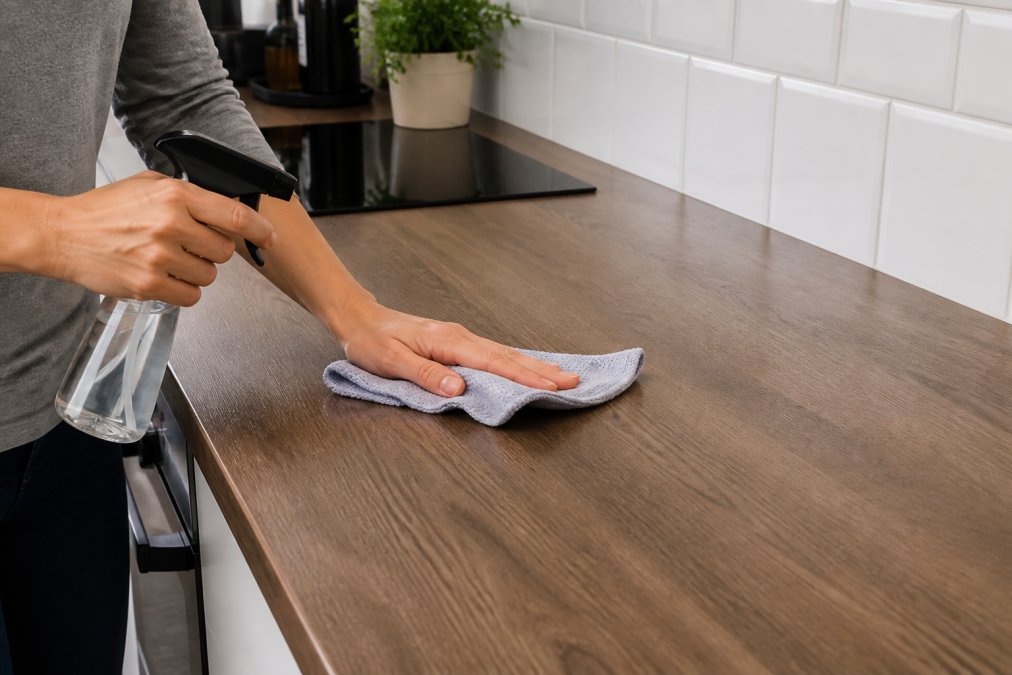
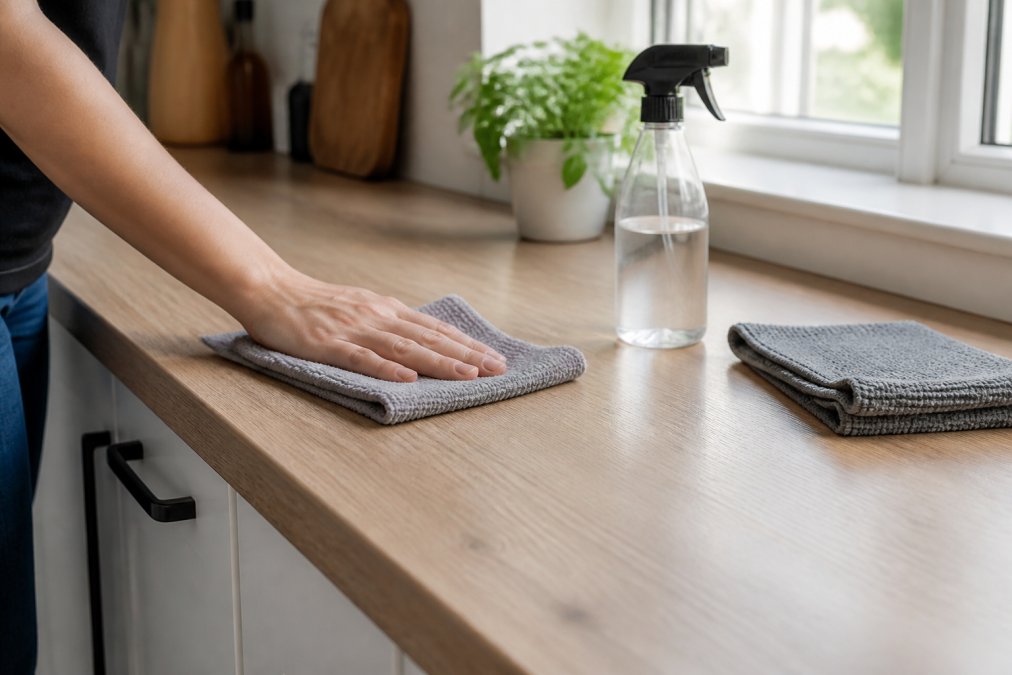
The daily routine takes under a minute and prevents the majority of long-term problems. Wipe the surface with a damp cloth and a small amount of mild washing-up liquid, then dry it immediately with a clean, dry cloth.
Work in this order:
- Clear crumbs and loose debris with a dry cloth or soft brush.
- Wipe with warm water and a few drops of washing-up liquid.
- Rinse the cloth and wipe again to remove detergent residue.
- Dry the surface, paying particular attention to seams and edges.
The drying step is the one most people skip, and it matters. Water left standing at a joint or along an unsealed edge can seep into the core over time, causing the laminate to swell (How to Join & Seal Laminate Worktops). A microfibre cloth guide from E-Cloth explains how a good microfibre cloth lifts grease with water alone, which reduces how much detergent you need.
Best Cleaning Products for Laminate Worktops
The best cleaning products for laminate worktops are mild, pH-neutral and non-abrasive. You do not need a cupboard full of specialist sprays; a small, well-chosen set covers almost every situation.
| Product | Best For | Notes |
|---|---|---|
| Mild washing-up liquid | Everyday wiping | Dilute in warm water; dry after use |
| Microfibre cloth | Streak-free drying | Machine washable; no chemicals needed |
| Bicarbonate of soda paste | Stubborn stains | Use with water; rinse thoroughly |
| Diluted white vinegar | Water marks, light limescale | Dilute; do not leave standing |
| Specialist kitchen degreaser | Dried-on grease | Test on a hidden area first |
Bicarbonate of soda is the most useful single item in the cupboard. Mixed with a little water into a paste, it lifts dried food and discolouration without the harsh abrasives found in cream cleaners. Diluted white vinegar handles water marks and light limescale, but it is acidic, so rinse and dry the area afterwards rather than leaving it wet.
Manufacturers often publish their own care guidance for specific ranges. The Egger laminate care guidance is a useful reference if you know the brand of your worktop, because some finishes have particular requirements.
How to Remove Stubborn Stains, Grease and Water Marks
Stubborn marks usually come off with the right technique rather than a stronger chemical. Match the method to the stain and give it a little time to work.
- Grease and cooking splatter: apply a specialist kitchen degreaser, leave for a minute, then wipe and rinse.
- Dried-on food: soften first with a warm, wet cloth for a few minutes before wiping.
- Water marks and light limescale: wipe with diluted white vinegar, then rinse and dry.
- Tea, coffee and food colouring: a bicarbonate of soda paste usually lifts these if treated promptly.
- Ink or marker: try a small amount of methylated spirits on a hidden area first, then wipe clean.
The single biggest mistake is scrubbing harder when a stain resists. Abrasive pads and aggressive scrubbing wear away the sheen and leave a dull patch that no cleaner will restore. If a mark will not lift with the methods above, it may be staining below the surface rather than on it, which is a different problem entirely.
What Never to Use on Laminate Worktops
Certain products cause damage that cannot be cleaned away, only repaired. Avoid these entirely:
- Abrasive powders, scouring pads and wire wool
- Bleach and strong multi-surface cleaners left to sit
- Oven cleaner or drain cleaner, which can etch the surface
- Acetone, nail varnish remover and strong solvents
- Steam cleaners, which can lift edges and force moisture into seams
- Hot pans placed directly on the surface
Steam is a particular trap because it feels like a thorough clean. In practice, the heat and moisture can soften the adhesive at seams and edges, and once water gets into the core board the swelling is permanent. Always use a trivet or mat under hot items, and never cut directly on the worktop.
Repairing Chipped Laminate Worktops: What's Possible
A chipped or burnt laminate worktop can often be repaired rather than replaced, provided the damage is assessed honestly. Repairing chipped laminate worktops is a specialist job: the technician prepares the damaged area, rebuilds or fills it, then reproduces the colour, texture and pattern before applying a suitable finish.
This is where professional repair changes the maths. A full worktop replacement means stripping out the old surface, cutting and fitting a new one, and often dealing with tiling, sealing and plumbing along the way. An in-situ repair avoids all of that disruption and keeps the existing surface in place.
Surface Magic Repairs has completed more than 46,000 surface repairs in the last year, and laminate worktop damage is one of the most common jobs they attend. Suitability always depends on the material, condition, location and extent of the damage. Shallow chips, scratches, burns and impact marks are usually good candidates. Deep damage that has compromised the core, or damage along a seam where moisture has already swollen the board, may be better served by replacement, and we will say so plainly.
Protecting and Maintaining the Finish Long Term
Long-term protection is mostly about small, consistent habits. Chopping boards, trivets and prompt drying do more for a laminate worktop than any single product.
A few practical measures extend the life of the finish considerably:
- Use a chopping board for all cutting, every time.
- Place trivets or mats under hot pans and dishes.
- Wipe up spills, especially oil, wine and citrus, as soon as they happen.
- Dry seams and edges after cleaning to stop water seeping in.
- Re-seal any exposed core edges if the laminate has lifted.
If the finish has become dull through years of use, a light application of a food-safe oil, buffed off thoroughly, can restore some sheen. Use it sparingly; too much leaves a greasy film that attracts dust. For deeper dullness or a patchy appearance, professional refinishing can restore the surface more evenly than any home product.
When a Laminate Worktop Should Be Replaced Rather Than Repaired
Replacement is the right call in some cases, and an honest assessment matters more than a quick sale. Repair is not suitable for every worktop.
Consider replacement when:
- The core board has swollen or crumbled from water ingress
- The damage spans a large area or affects structural integrity
- The laminate has lifted across a wide section, not just at one point
- The worktop is coming to the end of its serviceable life anyway
- A repair would cost more than it is worth relative to a new surface
For everything else, repair usually wins on cost, disruption and waste. Surface Magic Repairs operates from a base in Bolton and covers Greater Manchester and the wider North West, with nationwide availability for suitable commercial and multi-site projects. If you are unsure which route makes sense, send clear photographs of the damage, the complete worktop and the surrounding area, along with your address and postcode, and we will assess whether a repair is suitable.
Damaged laminate does not automatically mean a new kitchen. Whether it is a chip, a burn or a scratch that will not clean away, the sensible first step is an honest assessment rather than a replacement quote. Surface Magic Repairs repairs laminate worktops in place, with colour and finish matched to the surrounding surface, no strip-out required and far less disruption than fitting a new worktop. Send your photographs, address and postcode to info@surfacemagicrepairs.com or call 0800 085 7773, and we will tell you honestly whether repair or replacement is the better answer.
Frequently Asked Questions
What is the best way to clean laminate worktops without damaging them?
Use a mild pH-neutral washing-up liquid diluted in warm water, applied with a soft microfibre cloth. Wipe the surface, then dry it straight away with a second clean cloth to prevent water marks. For everyday spills, plain water and a microfibre cloth are often enough. Avoid abrasive pads, cream cleaners and anything containing bleach, as these wear away the protective layer that keeps laminate worktops looking new.
Can you use bleach on laminate worktops?
No. Bleach and chlorine-based cleaners attack the resin surface of laminate, causing fading, white patches and a dull finish over time. They can also damage the sealed edges where water is most likely to get in. For disinfection, use a diluted white vinegar solution or a plant-based multi-surface cleaner instead, and always dry the worktop afterwards.
How do you remove stubborn stains from laminate worktops?
Make a paste from bicarbonate of soda and a little water, apply it to the stain with a soft cloth and leave it for a few minutes before wiping away. For grease, a dedicated kitchen degreaser works well. Rinse thoroughly and dry. If a stain has soaked into a chipped or worn area, cleaning alone will not lift it; that damage usually needs professional repair.
Can repairing chipped laminate worktops save the surface from replacement?
In many cases, yes. Surface Magic Repairs repairs chips, scratches and burns on laminate worktops in place, matching the colour and texture so the damaged area blends with the surrounding surface. Suitability depends on the material, the extent of the damage and its location, so the company will give an honest assessment. Send clear photographs of the damage, the whole worktop and the surrounding area, plus your address and postcode, to get a quotation.