Table of Contents
- The Short Answer: When Repairing Kitchen Worktops Pays Off
- The Real Cost of Kitchen Worktop Repair vs Replacement
- The Hidden Costs of Replacement: Time, Mess and Knock-On Work
- Which Worktop Materials Can Be Repaired?
- Damage Types: What a Professional Repair Can and Cannot Fix
- How Long Does a Professional Worktop Repair Last?
- The Environmental Case: Keeping Materials Out of Landfill
- How to Get a Quote for Surface Repairs
- When Replacement Is the Better Option
- Conclusion: Making the Right Call for Your Kitchen
- Frequently Asked Questions
Last Updated: September 13, 2026
The Short Answer: When Repairing Kitchen Worktops Pays Off
Repairing kitchen worktops is worth it when the damage is cosmetic, the surface is structurally sound, and the worktop is otherwise in good condition. In those cases, a professional repair costs far less than replacement, avoids stripping out units and tiles, and keeps a serviceable material in use. This guide from Surface Magic Repairs explains where the line sits between a sensible repair and a job that genuinely needs replacing.
The practical test comes down to four questions: what the worktop is made of, how deep the damage goes, where on the surface it sits, and whether the substrate underneath is still sound. Answer those honestly and the decision usually makes itself.
Below, we break down the real cost drivers, the materials that can be repaired, the damage types worth attempting, and the situations where replacement is the better call.
The Real Cost of Kitchen Worktop Repair vs Replacement
A repair almost always costs less than a replacement, but the gap is wider than most people expect once you count the knock-on work. Replacing a worktop is rarely just a worktop. It pulls in labour to remove the old surface, disposal, new material, cutting and fitting, and often re-tiling, re-sealing and decorating around the edges.
A repair keeps all of that intact. The technician works on the damaged area in place, matches the colour and finish, and leaves the surrounding kitchen untouched. Surface Magic Repairs has completed more than 46,000 surface repairs in the last year, and the pattern is consistent: the more integrated the worktop is with the rest of the kitchen, the stronger the case for repair.
What Actually Drives the Cost of a Repair
Several factors move the cost of kitchen worktop repair up or down:
- Material: laminate and MFC are quicker to work with than quartz or granite
- Damage type and depth: a surface scratch is simpler than a deep burn or a crack
- Location: damage near a sink cut-out or edge is more involved than a mid-run chip
- Access: a clear worktop is easier to work on than one crowded with appliances
- Number of repairs: several small repairs in one visit usually cost less per repair than separate call-outs
- Finish matching: a plain colour is simpler to blend than a patterned or speckled surface
Because these vary so much from job to job, no honest company quotes a flat figure without seeing the worktop. Pricing depends on the surface, damage, location, access, finish and number of repairs.
The Hidden Costs of Replacement: Time, Mess and Knock-On Work
Replacement is not just a materials bill. It is a project. Removing a worktop means disconnecting and reconnecting sinks and hobs, lifting tiles or upstands, and protecting floors and units from dust and debris. In a busy household or a rented property, that is days of disruption, not hours.
The knock-on work is where budgets quietly grow. New worktops rarely match old tiles, so tiling gets redone. Sealant lines need redoing. Decorating near the edges often follows. For landlords, that can mean a void period between tenancies. For hotels and commercial kitchens, it can mean a closed service area.
A repair sidesteps nearly all of it. The worktop stays where it is, the units stay fitted, and the room stays usable. That is the core of the "Why Replace When You Can Repair?" approach: restore what is there rather than dismantling a working kitchen to fix one damaged patch.
Which Worktop Materials Can Be Repaired?
Most common worktop materials can be repaired in some form, but suitability depends on the material, the condition of the surface, the location and the extent of the damage. A repair that works well on a laminate chip may be unsuitable on a cracked quartz edge, and vice versa.
Laminate and MFC Worktops
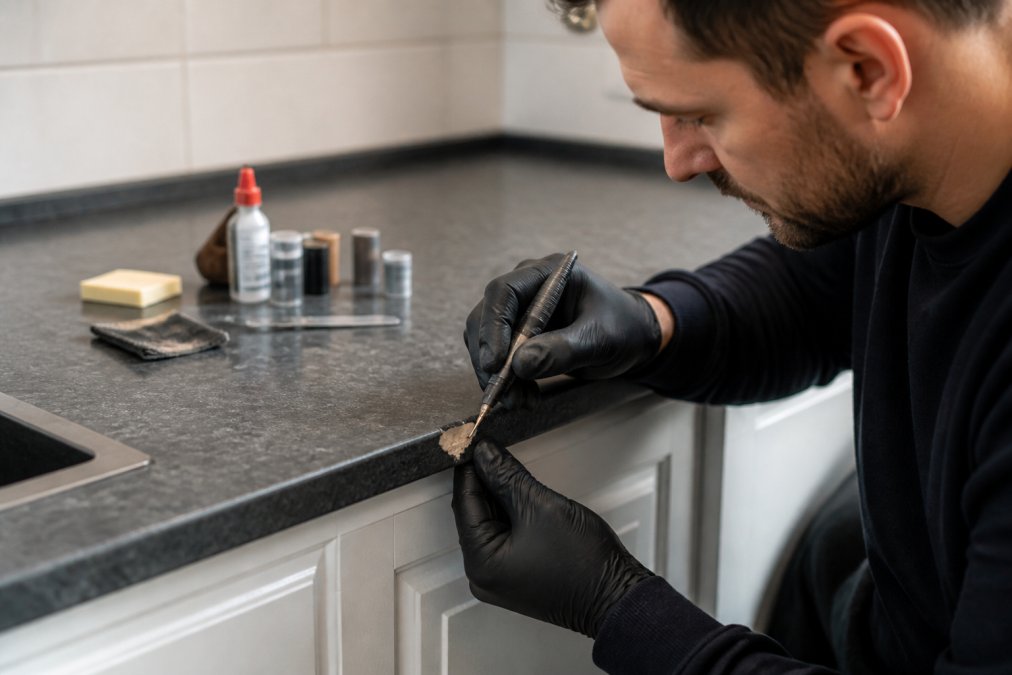
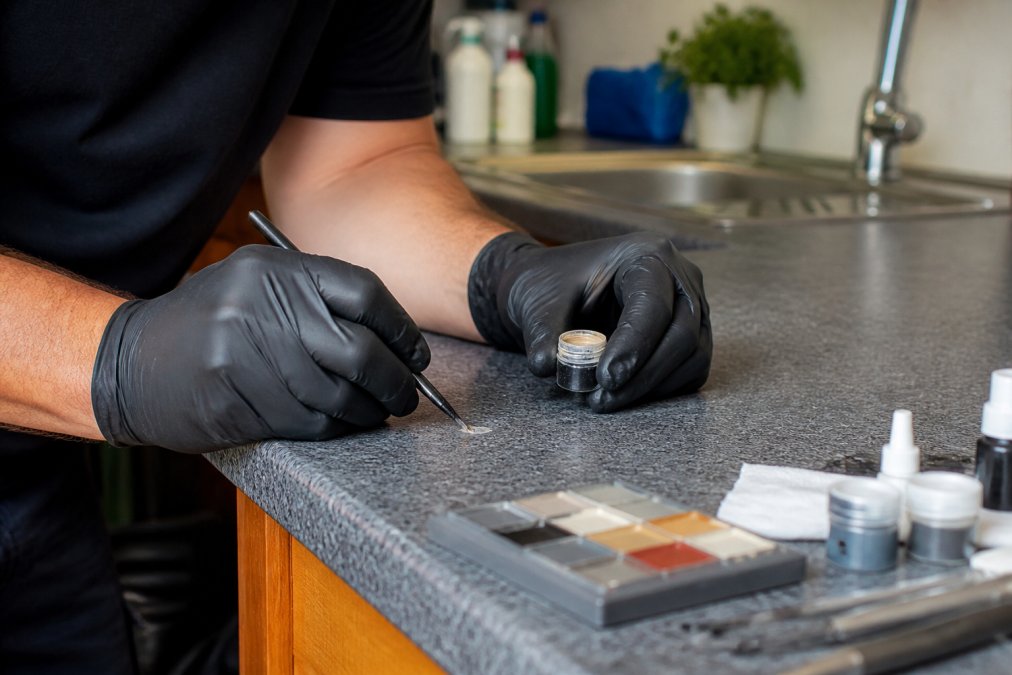
Laminate and MFC worktops are among the most repairable surfaces. Chips, scratches, burns and small impact marks can typically be filled, colour matched and refinished so the damaged area blends with the surrounding pattern. The main limitation is the pattern itself: a heavily textured or strongly patterned laminate is harder to match than a plain one, and a repair near a joint or edge may be more visible than one in the middle of a run.
Solid Surface, Quartz and Stone
Solid surface materials are often the easiest to restore because scratches and light damage can be sanded and polished back to the original finish (the NHS). Quartz, granite and stone can also be repaired, subject to assessment. Small chips and cracks are usually treatable, but the outcome depends on the colour, veining and finish of the specific slab. A material with dramatic natural veining is harder to blend invisibly than a uniform one.
| Material | Repair Suitability | Typical Damage Repaired | Main Limitation |
|---|---|---|---|
| Laminate / MFC | High | Chips, scratches, burns, impact marks | Pattern matching on textured surfaces |
| Solid surface | High | Scratches, chips, dull patches | Deep structural cracks |
| Quartz | Assessed case by case | Small chips, edge damage | Veined or patterned finishes |
| Granite / stone | Assessed case by case | Chips, surface marks | Natural variation between areas |
Damage Types: What a Professional Repair Can and Cannot Fix
Cosmetic damage is usually repairable. Structural failure usually is not. That is the simplest way to sort damage into a yes or a no.
Typically repairable:
- Chips and small gouges
- Scratches and scuff marks
- Burns and scorch marks on laminate
- Small cracks that have not spread
- Dents and impact marks
- Staining and worn finishes
Often better replaced:
- Cracks that run through the full thickness of the worktop
- Swelling or blown substrate from water ingress
- Damage around a sink or hob cut-out that has compromised the structure
- Large sections where the material has failed, not just the surface
A common mistake is assuming a deep burn means replacement. On laminate, a burn that has scorched the surface layer but not broken through the core is often repairable. Where it has charred into the substrate, replacement becomes the honest recommendation.
How Long Does a Professional Worktop Repair Last?
A properly executed repair on a suitable surface typically lasts for years, and often for the remaining life of the worktop (bsigroup.com). Longevity depends less on the repair itself and more on how the surface is treated afterwards.
Repairs hold up best when the area is cleaned with gentle products rather than abrasives, when hot pans are kept off the surface, and when chopping takes place on a board rather than the worktop. In busy commercial kitchens and hotel rooms, the same rules apply but with more traffic, so a repair that is well matched and correctly finished is what keeps it looking right over time.
The Environmental Case: Keeping Materials Out of Landfill
Every worktop that is repaired instead of replaced is one less composite board, stone slab or laminate sheet going to waste. Worktops are bulky, heavy and rarely recycled in practice, so replacement sends a serviceable material to landfill to fix a localised problem.
Repair also avoids the secondary waste that comes with replacement: old tiles, sealant, packaging and offcuts. For organisations working to reduce their environmental impact, surface repair is one of the simpler wins available, because it removes waste at the source rather than managing it afterwards. Guidance from WRAP on reducing construction and fit-out waste sets out how keeping materials in use cuts both waste and carbon.
How to Get a Quote for Surface Repairs
Getting a quote for surface repairs is straightforward, and you can usually get one without a site visit. Send clear photographs of the damage, the complete item and the surrounding area, together with your full address and postcode. Surface Magic Repairs can then assess whether a repair is suitable and provide a quotation.
Include the following when you enquire:
- A close-up of the damage, in good light
- A wider shot showing the whole worktop
- A shot of the surrounding kitchen or room
- The worktop material, if you know it
- Your full address and postcode
- How many separate areas need attention
For domestic work further from Bolton, sending the job details and postcode first lets availability be checked before anything is booked. Commercial and multi-site projects, including hotels, housing providers and new-build developments, can be scheduled as planned visits across several properties.
When Replacement Is the Better Option
Replacement is the right answer when the worktop has failed structurally, not just cosmetically. If the core has swollen from water ingress, if a crack runs through the full thickness, or if the damage has compromised the area around a cut-out, a repair will not restore the strength the worktop needs.
There are also cases where replacement makes practical sense even when a repair is possible. If the worktop is already at the end of its life, or if a redesign is planned anyway, spending on a repair may not be the best use of money. Honest assessment matters here. Surface Magic Repairs will advise when replacement would be more appropriate or durable rather than pushing a repair that will not hold up.
That honesty is the point. A repair is the better call in most cosmetic cases, but not all of them, and a company that tells you which is which is worth more than one that always says yes.
Conclusion: Making the Right Call for Your Kitchen
The decision comes down to damage type and material, not gut feeling. Cosmetic damage on a sound worktop is almost always worth repairing. Structural failure is not, and no amount of colour matching will fix a swollen core.
If your worktop has a chip, scratch, burn or small crack and the surface is otherwise sound, a repair is very likely the sensible choice: cheaper than replacement, far less disruptive, and it keeps the existing material in use. If the damage runs deeper, replacement may genuinely be the better long-term answer.
Send clear photographs of the damage, the complete item and the surrounding area, together with your full address and postcode. Surface Magic Repairs can assess whether a repair is suitable and provide a quotation. Call 0800 085 7773 or visit surfacemagicrepairs.co.uk to get started.
Frequently Asked Questions
Can you repair a chip in a laminate worktop?
Yes, small chips, scratches and burns on laminate worktops can often be repaired professionally. A technician will fill the damaged area, match the colour and pattern of the surrounding laminate, and apply a protective finish. The result significantly improves the appearance and prevents moisture from getting into the core, which is where swelling starts. Suitability depends on the size and location of the damage, so sending clear photographs to a specialist for assessment is the best first step.
Is it cheaper to repair or replace a kitchen worktop?
Repairing is almost always cheaper than replacing a kitchen worktop. Replacement involves the cost of the new worktop itself, plus labour for removal and installation, and often the knock-on expense of re-tiling, decorating or adjusting cabinets. A repair is completed in place and targets only the damaged area. The exact cost of kitchen worktop repair depends on the material, the extent of the damage and the number of repairs needed, so a professional assessment is required for an accurate figure.
How long do professional worktop repairs last?
A professionally completed worktop repair can last for many years when it is properly executed and the surface is cared for correctly. The longevity depends on the repair method used, the material, and how the worktop is treated afterwards. Avoiding harsh abrasives, using chopping boards and trivets, and cleaning with appropriate products will all help extend the life of the repair. A specialist can advise on the best aftercare for your specific worktop material.
When is a worktop beyond repair?
A worktop may be beyond economic repair if the damage is structural, such as a large crack that compromises the integrity of the surface, or if the damage covers a wide area. Significant water damage that has caused the core of a laminate worktop to swell extensively is another common reason replacement becomes the more sensible option. An honest assessment from a specialist will confirm whether a repair is viable or whether replacement would be more durable.