Quick Summary
The best worktop oil for a solid wood kitchen worktop is usually a hardwax oil, because it penetrates the timber and hardens into a durable, water-resistant layer. Check that the cured finish is suitable for food contact and allow the full curing period before use.
- Hardwax oils are the most widely recommended choice for kitchen worktops.
- Look for water resistance, food-contact suitability, easy recoating and grain enhancement.
- Food-contact claims usually apply to the fully cured finish, not the wet oil.
- Apply two thin coats and wipe off excess oil after 15 to 20 minutes.
- Oil most worktops once or twice a year, spot-treating heavily used areas.
Table of Contents
- What Makes a Worktop Oil Suitable for a Kitchen
- Comparing the Main Worktop Oils: Pros and Cons
- Food-Safe Worktop Oil: What the Labels Really Tell You
- Choosing Oil by Wood Species and Worktop Condition
- How to Oil a Worktop Step by Step
- How Often to Oil Wooden Worktops and Signs It Is Due
- Troubleshooting Common Application Problems
- Deciding Whether to Oil, Repair or Replace Your Worktop
- Frequently Asked Questions
Best Oil for Solid Wood Worktops: A Practical How-To Guide
Last Updated: November 5, 2026
What Makes a Worktop Oil Suitable for a Kitchen
A suitable worktop oil needs to do three jobs at once: seal the timber against water and spills, leave the surface safe for food preparation, and be easy to repair when it wears. Not every oil does all three well, and the label rarely tells the whole story.
Surface Magic Repairs works on damaged surfaces every day, and the same principle applies to oil: a finish that is easy to recoat will serve a kitchen far better than one that demands stripping back. Think about how your worktop is used before you choose a product. A breakfast bar that sees little water needs a different finish from a sink run that gets soaked daily.
Look for four practical qualities:
- Water resistance, so spills bead rather than soak in
- Food-contact suitability, confirmed on the product label or by the manufacturer
- Ease of recoating, so small areas can be refreshed without sanding everything
- Grain enhancement, if you want the timber to look richer rather than plastic
Comparing the Main Worktop Oils: Pros and Cons
Three families of finish dominate kitchen worktops. Each suits a different kind of kitchen.
Hardwax oils
Hardwax oils combine plant oils with waxes. They are the most widely recommended choice for kitchen worktops because they penetrate the timber and then harden into a durable, water-resistant layer.
Pros:
- Strong water resistance once cured
- Enhances the natural grain without a heavy film
- Spot repairs are straightforward, which suits busy kitchens
Cons:
- Needs a full drying period before the worktop returns to use
- Some products are more expensive per square metre than basic oils
Check the current product label of any hardwax oil before purchase, as formulations can change, and confirm the food-contact wording with the manufacturer.
Danish oil for kitchen worktops
Danish oil is a traditional oil-and-varnish blend. It soaks into the wood and gives a warm, slightly amber finish. Its performance varies because "Danish oil" describes a category rather than one product.
Pros:
- Easy to apply and cheap to top up
- Gives a warm, traditional appearance
Cons:
- Protection is typically thinner than hardwax, so spills need wiping promptly
- Specifications differ widely between brands, so the label matters
Traditional linseed-based oils
Boiled linseed oil has long been used on solid timber. It darkens the wood and dries slowly. Some care guides list it as an option for worktops, but it does not always meet modern expectations for food contact or water resistance. Always check the specific product's instructions and its suitability for kitchen use before applying anything to a surface you prepare food on.
Food-Safe Worktop Oil: What the Labels Really Tell You
"Food-safe" is the phrase most likely to mislead buyers. A label may say a product is suitable for food contact, but the wording on the tin only means something if you can trace it to a recognised standard and understand what that standard actually covers.
Food-contact claims on wood finishes should refer to a recognised standard. The relevant claim is usually that the fully cured film is suitable for food contact, not that the liquid oil is safe to ingest or approved for use during application.
This distinction matters because many oils are food-safe only once they have fully cured. While the oil is still wet, tacky or curing, it can transfer residue to food and should not be used for preparation. The manufacturer's curing time is the point at which the finish becomes suitable, not the drying time between coats.
Three practical points follow:
- Curing matters more than the claim. An oil that has not fully cured can transfer residue. Follow the full curing period on the label before food touches the surface, often several days for hardwax oils, longer in cool or humid conditions.
- Anti-bacterial claims are not the same as food-safe claims. A product marketed as anti-bacterial is not automatically suitable for food preparation. Read the manufacturer's statement on food contact, not the marketing headline.
- Re-oiling resets the clock. After a fresh coat, the worktop should be treated as uncured until the manufacturer's curing time has passed again. Plan re-oiling for a quiet period when the kitchen can be out of action.
If you are unsure whether a product's food-contact claim applies to your intended use, contact the manufacturer before purchase. A reputable supplier will confirm which standard the claim refers to and whether it applies to the cured finish or the product as supplied.
The table below summarises the key curing and food-contact points from this section, so you can check them before using the worktop.
| Point | What to do | Why it matters |
|---|---|---|
| Curing before food contact | Follow the full curing period on the label | Uncured oil can transfer residue to food |
| Typical hardwax curing | Often several days | Longer in cool or humid conditions |
| Anti-bacterial claims | Check the manufacturer's food-contact statement | Anti-bacterial is not the same as food-safe |
| After re-oiling | Treat as uncured again | Fresh coats restart the curing clock |
| Food-contact claim | Confirm which standard it refers to | Claim may apply only to the cured finish |
| Unsure about a product | Contact the manufacturer before purchase | A reputable supplier will confirm the standard |
Choosing Oil by Wood Species and Worktop Condition
Timber density and condition change how an oil absorbs, so the species and the state of the worktop matter as much as the product name. A finish that suits a new oak worktop may behave differently on dense beech or on a surface that has been oiled for years.
Denser timbers such as beech, bamboo and walnut tend to take oil more slowly and often suit thinner oils or products formulated for dense woods. Some manufacturers offer specific guidance for these species; check the product data sheet rather than relying on general advice.
Oak is porous and responds well to hardwax finishes, which build a water-resistant layer without forming a heavy film. A common approach is to use a clear hardwax oil over a suitable base coat, but always follow the manufacturer's system for the specific product.
Condition matters as much as species. A worktop with dry, grey patches needs a thorough clean and a light sand before any oil goes on. A recently oiled surface that simply looks tired may only need a fresh coat. A worktop with an unknown finish, for example in a newly purchased property, should be tested in an inconspicuous area before applying anything, because some finishes will not bond over others.
For damaged worktops, oil is not a repair. Deep scratches, chips, burns or cracks need a proper repair before oiling, otherwise the damage will show through the new finish. Our guide to fixing chips, burns and scratches on kitchen worktops explains how these repairs are carried out. Surface Magic Repairs carries out in situ repairs to burns, chips and scratches on laminate and solid-surface worktops. Suitability depends on the material and the extent of the damage, and Surface Magic Repairs will advise honestly if replacement would be more appropriate.
How to Oil a Worktop Step by Step
Set aside a full day for the job, and plan for the surface to be out of use until the finish has cured.
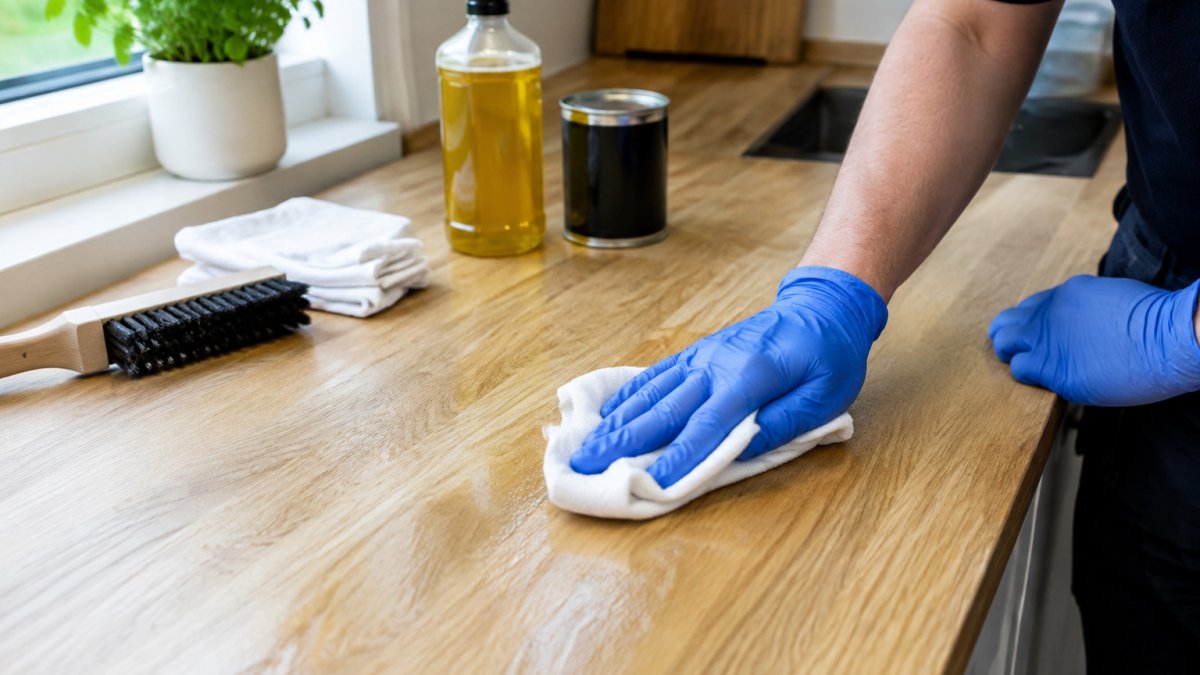
- Clear and clean the surface. Remove everything and wipe with a damp cloth, then let it dry completely.
- Sand lightly. Work with the grain using fine-grit sandpaper. Wipe away the dust.
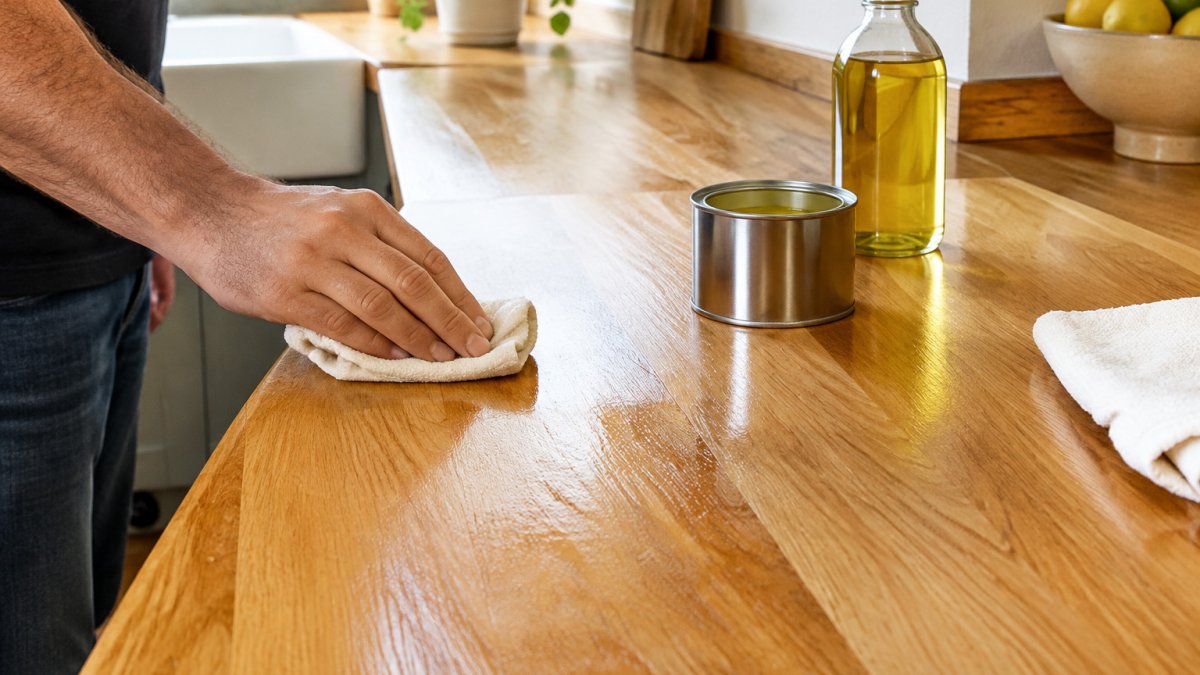
- Apply a thin first coat. Use a lint-free cloth and spread the oil evenly along the grain.
- Wipe off the excess. Remove any oil that sits on the surface after about 15 to 20 minutes. Leftover oil stays tacky and will not cure properly.
- Allow drying time. Follow the label. Many hardwax oils need several hours between coats and a longer period before food contact.
- Apply further thin coats. Two coats are common for good protection. Thin coats cure more reliably than one thick one.
- Allow full curing. Do not use the worktop for food until the manufacturer's curing period has passed.
Watch out: pouring oil on the surface and leaving it to soak in is a common mistake. Excess oil that is not wiped away will leave a sticky film that is hard to fix.
How Often to Oil Wooden Worktops and Signs It Is Due
Most kitchen worktops need attention roughly once or twice a year, depending on use. Heavy sink areas and chopping zones wear faster than the rest of the surface.
Look for these signs that the surface needs oiling:
- Water no longer beads on the surface and soaks in instead
- The timber looks dry, pale or greyish in high-use areas
- Small stains appear where liquids have penetrated
- The surface feels rough or slightly raised near the sink
Spot-treat worn areas rather than re-oiling the whole worktop each time. This keeps maintenance quick and avoids building up too much finish.
Troubleshooting Common Application Problems
Sticky or tacky patches. This usually means too much oil was left on the surface. Wipe the area with a cloth lightly dampened with the solvent recommended on the label, then allow it to dry and apply a thinner coat.
Blotchy or uneven colour. Uneven absorption often comes from sanding unevenly or applying too much oil in one spot. Lightly sand the blotchy area and recoat thinly.
Oil wiped away after a day. If a finish is wiped off during routine cleaning soon after application, it has usually not cured. Give the product its full curing time before cleaning the surface regularly.
Chips, burns or scratches. Oil does not repair damage. Deep marks need a proper repair. Surface Magic Repairs carries out in situ repairs to burns, chips and scratches on laminate and solid-surface worktops, so a damaged area can often be restored without replacing the whole worktop. Results depend on the material and the extent of the damage.
Deciding Whether to Oil, Repair or Replace Your Worktop
Oiling works well for surface wear and dryness. Repair is the right route for chips, burns or cracks that oil cannot hide. Replacement makes sense when the timber is badly delaminated, the structure is failing or the worktop has been damaged beyond a sensible repair.
As a rule, oil the worktop when the surface is dry or tired, repair it when the damage is physical, and replace it only when the worktop cannot be restored safely. For a practical comparison of your options, see our guide to replacing kitchen worktops step by step. If you are weighing up whether repair is worth the cost, our 2026 guide to repairing kitchen worktops covers the factors to consider, and surface restoration as a lower-cost alternative to replacement explains how that compares in cost and effort.
Send clear photographs of the damage, the complete worktop and the surrounding area, together with your full address and postcode, and Surface Magic Repairs can assess whether a repair is suitable and provide a quotation. You can also call 0800 085 7773 or visit surfacemagicrepairs.co.uk.
Frequently Asked Questions
What is the best oil for solid wood kitchen worktops?
There is no single best oil for every worktop. Hardwax oils are widely favoured for kitchen use because they penetrate the wood, harden on the surface and resist water and everyday wear, while still allowing the grain to show. Dense timbers such as beech, bamboo and walnut take oil more slowly, so check the product data sheet for the species you have. Check the manufacturer's label for food-safety wording and follow its application instructions, since suitability varies by product and timber.
Can you use Danish oil on a wooden kitchen worktop?
Yes, Danish oil is commonly used on kitchen worktops. Water resistance and food-contact suitability depend on the specific product, so check the label. Because Danish oil is a finish category rather than one fixed product, its composition differs between brands. Confirm that the specific Danish oil you buy is labelled suitable for food-contact surfaces before using it where food is prepared.
How long does worktop oil take to dry?
Drying and curing times depend on the product, the number of coats, the temperature and the humidity in the room. Thin coats dry more quickly than heavy ones, and most manufacturers advise leaving a worktop unused for a set period before water or food contact. Read the label for the recommended drying time between coats and the full cure time before returning the surface to regular use.