Last Updated: November 28, 2026
Quick Summary
Worktop repair is usually possible between tenancies when the damage is cosmetic and localised, such as a chip, burn mark, scratch or small crack in laminate, solid surface or timber. Suitability depends on the material, the depth of the damage and whether the surface is still structurally sound. Swollen, lifting or structurally cracked worktops need replacement instead.
- Chips, burns, scratches and small cracks are often repairable; swelling, lifting and structural cracks are not.
- Swollen laminate cannot be flattened back reliably, so a repair then is cosmetic at best.
- Send four photographs: a close-up, the whole worktop, the surrounding area and a second angle.
- A repair is normally completed on site, so the property is usable again the same day in most cases.
- Book the repair as soon as the check-out inspection is done, not after the new tenant is confirmed.
Table of Contents
- Can you repair a damaged worktop between tenancies?
- Repair or replace kitchen worktop: how to decide
- Which worktop damage can be repaired and which cannot
- Laminate worktop chip repair and burn marks
- Solid surface, stone and timber worktops
- Worktop repair quotation photographs: what to send
- End of tenancy property repairs: evidence and deposit deductions
- Turnaround times and scheduling between tenancies
- Send your photographs and postcode to Surface Magic Repairs
- Frequently Asked Questions
Can you repair a damaged worktop between tenancies?
Yes, in many cases a damaged worktop can be repaired between tenancies rather than replaced. Worktop repair is usually possible when the damage is cosmetic and localised, such as a chip, burn mark, scratch or small crack in laminate, solid surface or timber. Suitability depends on the material, the depth of the damage and whether the surface is still structurally sound.
That answer matters because the changeover window is short. A repair completed in place avoids a strip-out, a templating visit and the decorating that often follows a new worktop. At Surface Magic Repairs, we assess photographs before booking so landlords know whether a repair is realistic or whether replacement is the more durable choice.
Below, we walk through how to decide, which damage is repairable, and what to send for a quotation.
Repair or replace kitchen worktop: how to decide
The decision comes down to three things: how localised the damage is, how long the worktop needs to last, and whether the kitchen is due for a wider refresh.
When a repair is the sensible choice
A repair is usually the better call when:
- The damage sits in one small area, such as a burn ring or chipped edge
- The worktop is otherwise sound, flat and well sealed
- The tenancy is continuing or restarting soon
- The kitchen units are staying as they are
- You want to avoid a strip-out and the tiling or decorating that follows
When replacement wins
Replacement makes more sense when the surface is lifting, swollen or cracked through. It is also worth considering if the worktop is near the end of its life, or if the kitchen units are due for replacement anyway. A contributor on Property Tribes landlord discussion on burnt worktops made a fair point: fitting a new worktop just before the units come out can be short-lived. If you are weighing up both routes, our guide to the cost of professional kitchen worktop restoration explains what restoration involves.
Which worktop damage can be repaired and which cannot
Chips, burns, scratches, stains and small cracks are often repairable. Structural damage is not. The dividing line is whether the surface is still doing its job, and that line sits in a different place for each material.
| Damage type | Usually repairable? | What decides it |
|---|---|---|
| Surface chip or nick | Yes | Depth and edge location |
| Burn or scorch mark | Often | Whether the core is scorched |
| Scratch or scuff | Yes | Depth into the pattern layer |
| Surface crack | Sometimes | Whether it runs through the board |
| Swelling or lifting | No | Moisture has reached the core |
| Stain or discolouration | Often | Whether it sits in the surface or below |
If the board has swollen, the material is compromised and a cosmetic repair will not hold. A practical check: run a fingertip across the damage. If it catches sharply and the area around it feels soft or raised, get it assessed before assuming a repair will work.
Laminate worktops
Laminate is a printed pattern layer over a chipboard or MDF core. A chip or burn that stays within the pattern layer can usually be filled, coloured and refinished. Once the damage reaches the core, moisture can enter and the board swells. Swollen laminate cannot be flattened back reliably, so a repair at that point is cosmetic at best and short-lived. Deep cracks that run through the board, or failed joints where water has been sitting, are replacement cases.
Timber worktops
Solid timber is the most forgiving material. Light scratches, water marks and dull patches usually respond to sanding and re-oiling, and a good technician can blend the repaired area into the surrounding grain. The limits are deep gouges that remove too much thickness, splits along a glue joint, and any area that has been wet long enough to blacken and soften. Timber that has swelled around a sink cut-out often needs more than a cosmetic repair.
Solid surface worktops
Solid surface materials can usually be sanded, filled and refinished to a smooth, even finish, and seams can often be dressed back so they are far less visible. The main limits are heat damage that has discoloured the material below the surface, and cracks that have spread from a joint or cut-out. Suitability depends on the extent, so an assessment matters more than a promise.
Stone worktops
Quartz, granite and other stone are assessed case by case. Colour and veining are hard to reproduce, and some damage needs a specialist stone approach rather than a general surface repair. Chips at an edge are often treatable; cracks that run through a slab, or damage near a hob cut-out, may need a stone specialist. We will say honestly if a repair is not the right route.
Watch out: a repair that looks acceptable on the day can fail within weeks if the underlying cause, such as moisture ingress or a failed seal, has not been dealt with. Fix the cause before the cosmetic repair, or the damage returns.
Laminate worktop chip repair and burn marks
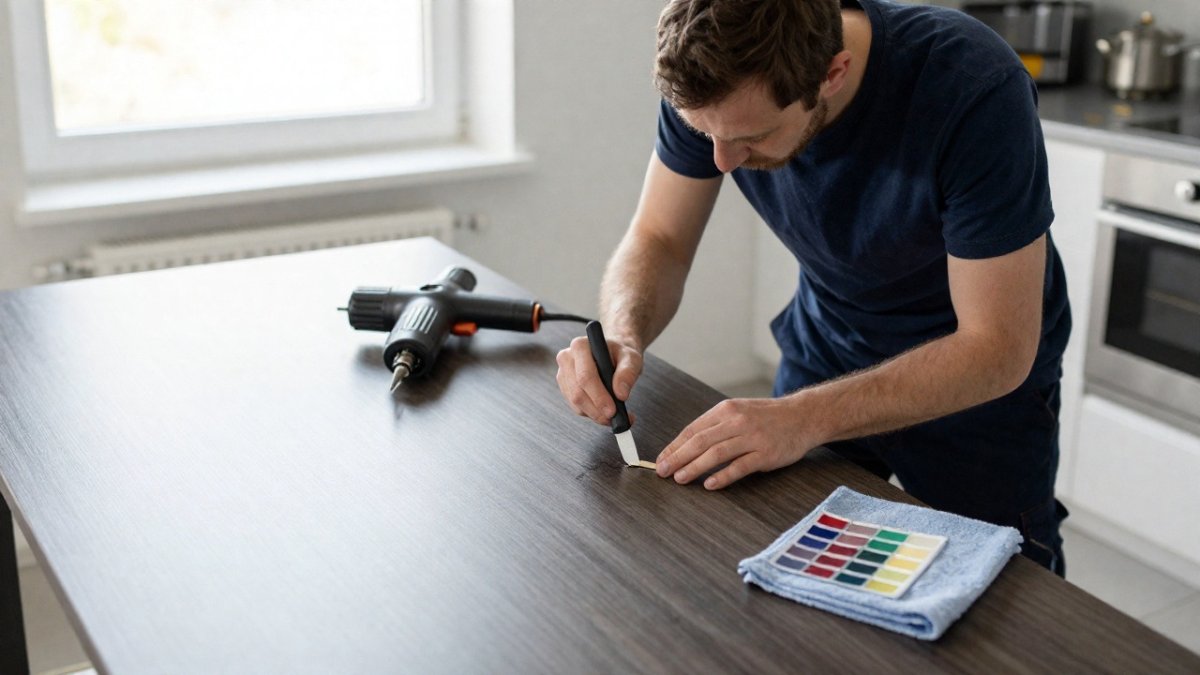
Laminate worktop chip repair is one of the most common jobs we see between tenancies. A hot pan set down without a trivet leaves a burn ring. A dropped mug takes a chip out of the edge. Both are usually cosmetic and both can often be filled, coloured and refinished to blend with the surrounding pattern.
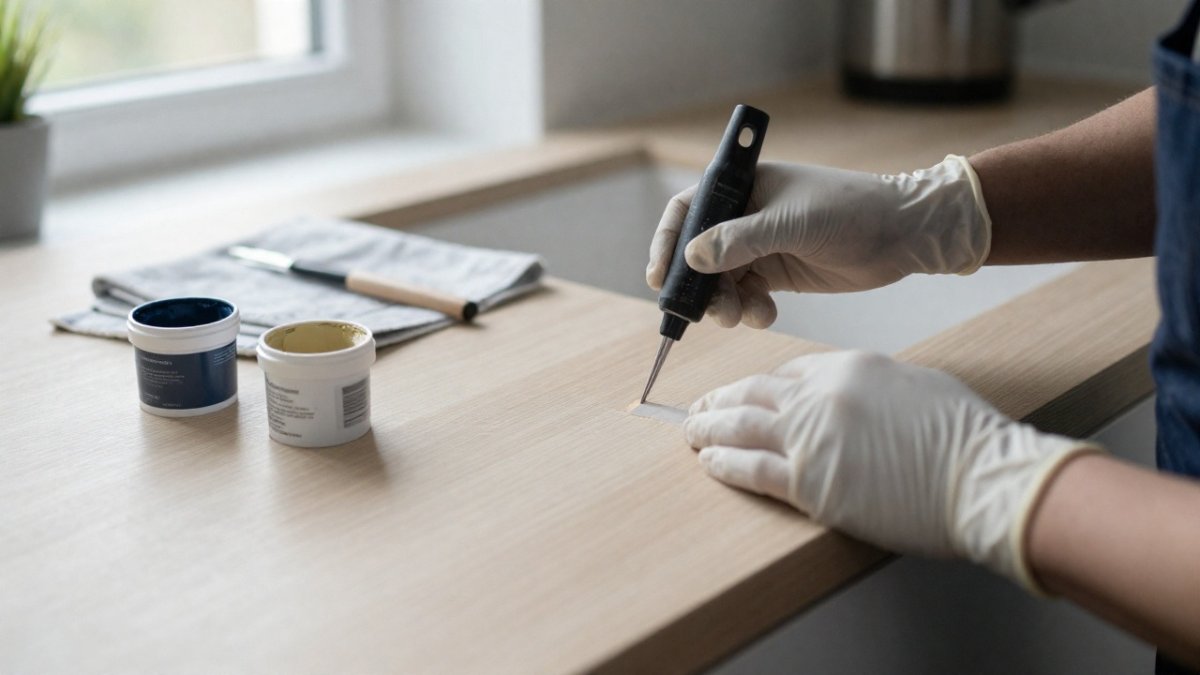
The catch is the pattern. Laminate is a printed layer, so matching a wood grain or stone effect takes care. A repair will significantly improve the look of the area, but we never promise it will be completely invisible. For deeper guidance on scratches specifically, see how to fix scratches on laminate worktops.
Watch out: sanding a laminate burn mark yourself often makes it worse. The printed layer is thin, and once it is cut through, the repair becomes harder and more visible.
Solid surface, stone and timber worktops
Solid surface materials such as quartz, granite and timber each behave differently. Solid surface and timber can often be sanded, filled and refinished. Stone is assessed case by case, because colour and veining are hard to reproduce and some damage needs a specialist stone approach.
Timber worktops respond well to sanding and re-oiling, which can remove light scratches and restore the finish. Solid surface can usually be refinished to a smooth, even surface. For stone, the honest answer is that suitability depends on the damage and the material, and we will say so before any work is booked.
Worktop repair quotation photographs: what to send
A worktop repair quotation photographs set is the fastest route to an accurate answer. We can usually quote from photographs, which saves a site visit before you know whether a repair is viable.
Send these four shots:
- A close-up of the damage in sharp focus
- The whole worktop in one frame
- The surrounding area, including units and edges
- A second angle of the damage under good light
Then add your full address and postcode. Good light matters more than a good camera. Take the close-up in daylight, not under a warm kitchen bulb, so the colour reads true.
End of tenancy property repairs: evidence and deposit deductions
End of tenancy property repairs live or die on evidence. A deposit deduction for worktop damage is far easier to justify with a dated check-in report, a matching check-out inspection and clear photographs of both. The distinction that matters is fair wear and tear versus tenant damage (Wear and tear in renting: What it means and how it is applied).
A documented process keeps the decision proportionate and defensible:
- Check-in record. Note the worktop material, age and condition at the start of the tenancy, with dated photographs of edges, joints and the area around the hob and sink.
- Check-out inspection. Photograph the same areas under similar light, so the comparison is fair.
- Age and condition allowance. A worktop that is already several years old has already lost some value, so a deduction should reflect the remaining life, not the price of a new worktop.
- Repair quotation. Get a written quotation for the repair rather than estimating a figure, so the deduction is tied to actual work.
- Decision and record. Keep the quotation, the photographs and the reasoning together, whether the cost is recovered from the deposit or accepted as wear and tear.
mydeposits case study on kitchen worktop damage reviews exactly this kind of dispute, and it shows why condition reports carry the weight. For a structured way to assess damage and decide what counts as chargeable, see how to assess rental property damage for repairs.
Judging whether a repair is fit for purpose
A repair is fit for purpose when it is stable, colour-matched to the surrounding surface and durable enough for normal use until the next changeover. Set expectations at the start: a repair will significantly improve the look of the area, but a printed laminate pattern or a veined stone finish is rarely reproduced invisibly. What matters for a tenancy is that the worktop is sound, clean and presentable, not that the repair is undetectable.
Reducing repeat damage
Simple guidance to tenants reduces the next claim: use a trivet under hot pans, wipe up spills around joints and the sink promptly, and avoid chopping directly on the surface. For food-contact areas, use products as instructed and allow adequate ventilation while any finish cures. These steps protect the repair and the deposit alike.
Turnaround times and scheduling between tenancies
Turnaround is where repair beats replacement. A replacement worktop needs measuring, templating, fabrication and a fit, which rarely fits a short changeover. A repair is normally completed on site, so the property is usable again the same day in most cases.
Scheduling is the real constraint. Book the repair as soon as the check-out inspection is done, not after the new tenant is confirmed. If you are managing several properties, group the jobs into one visit where the locations allow. Our guide to rental property maintenance scheduling covers how to fit repairs into a tight window.
Watch out: leaving a repair until the day before a new tenancy starts removes any margin. If a part needs ordering, the handover slips.
Send your photographs and postcode to Surface Magic Repairs
Surface Magic Repairs is Bolton-based and travels across Greater Manchester and the wider North West for scheduled work, with nationwide reach for suitable commercial projects. Repairs are completed in place, with colour and finish matched to the surrounding surface, so there is no strip-out and no knock-on tiling.
The company has repaired more than 46,000 surfaces in the last year, and the team has more than 25 years of combined trade experience. We will tell you honestly if replacement would be the more durable choice.
If you have several properties, you can group the work. Our guide to booking multiple surface repairs for rental properties explains how a coordinated visit works.
Send clear photographs of the damage, the complete item and the surrounding area, together with your full address and postcode. Surface Magic Repairs can assess whether a repair is suitable and provide a quotation. Call 0800 085 7773 or visit surfacemagicrepairs.co.uk.
Frequently Asked Questions
Can a damaged kitchen worktop be repaired between tenancies?
In many cases, yes. Chips, burns, scratches and cracks in laminate, solid surface and some stone worktops can often be repaired in place by a specialist rather than replaced. Suitability depends on the material, how localised the damage is and whether the surface is still structurally sound. A worktop repair is usually quicker and less disruptive than a full replacement, and it avoids stripping out units or retiling. Surface Magic Repairs will assess photographs honestly and say if replacement would be the better option.
What photographs should I send for a worktop repair quotation?
Send three clear, well-lit shots: a close-up of the damage, a wider shot of the whole worktop and a shot showing the surrounding kitchen so the finish and pattern can be judged. Include your full address and postcode with the images. Avoid blurry photos or harsh flash that hides the texture. Good worktop repair quotation photographs let Surface Magic Repairs assess suitability and give a realistic quote without a wasted site visit, which matters when a new tenant is due in days.
How long does a professional worktop repair take?
Most single worktop repairs are completed in a short on-site visit, with the technician preparing the area, filling or rebuilding the damage, matching the colour and pattern, then refinishing. Drying and curing times vary by material and product, so ask when the surface can be used again before booking a check-in. For multiple properties, scheduling several repairs in one run helps you hit tight turnaround windows between tenancies. Confirm timings when you request your quotation.
Is it better to repair or replace a damaged worktop in a rental property?
Repair usually costs less and causes far less disruption, so it is often the right call for localised chips, burns and scratches. Replacement makes more sense when the worktop is structurally unsound, the damage is widespread, or the units are due to be replaced anyway and a new worktop alone would be short-lived. Weigh repair cost against replacement cost, downtime and the age of the kitchen. Get an honest assessment first rather than assuming replacement is unavoidable.